
Solutions for
vaccines
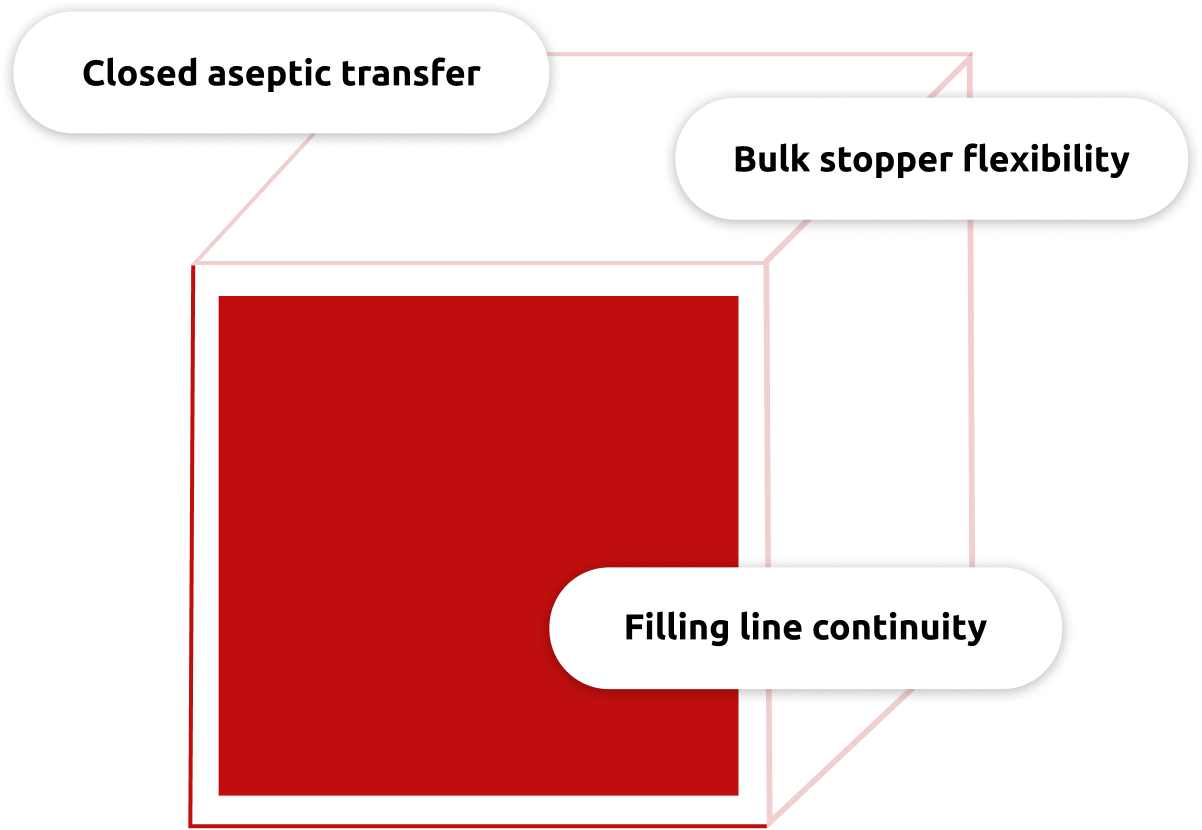
Vaccine manufacturing places exceptional demands on fill-finish operations, where product sterility depends on the controlled preparation and transfer of every component entering the aseptic filling area.
Sterile vials, stoppers and product-contact machine parts must be available in step with the filling line and introduced without contamination or particle exposure. Multiple preparation systems, intermediate containers and manual transfers increase process complexity, footprint and critical interfaces. Dependence on ready-to-use components can also limit sourcing and campaign flexibility.
Manufacturers must therefore protect product efficacy and container integrity while ensuring sterile-component availability, traceability and production continuity.
Request more information
FOR BIOLOGICAL AND OTHER HEAT-SENSITIVE VACCINES
we protect the aseptic process by coordinating the preparation and transfer of every critical component.
Vials are washed and depyrogenated, while stoppers and filling-line parts undergo dedicated washing, sterilization or combined washing-and-sterilization processes. Bulk stoppers can be washed, sterilized, dried and cooled in one system, then discharged into a sterile tank connected to the system during sterilization and maintained under controlled overpressure. Automated closed handling transfers the tank to the filling isolator, where an RTP connection preserves sterility up to the point of use.
The same system can process machine parts between campaigns, increasing utilization and flexibility.
Reduced exposure, controlled connection to the barrier and readiness for closed or robotic reassembly.
Maintains treated bulk stoppers within a closed sterile environment during transfer from the washing and sterilization system to the automated manipulator.
Controlled loading, unloading, movement, connection and delivery to reduce exposure and avoidable manual intervention.
Steam sterilization for compatible reusable parts packaged in bags or canisters before protected or closed transfer.
Integrated washing and sterilization of bulk closures, followed by closed transfer in a sterile tank.
Reusable heat-sensitive parts whose material, geometry, packaging and microbial-reduction requirements support a validated low-temperature route.
Sealed RTU or pre-sterilized materials whose internal sterile state must be preserved while the outer packaging is treated before entry.
Compact layouts, fewer equipment interfaces, reduced classified-space demand or a single integrated route for compatible reusable loads.
Validated washing establishes the required cleanliness state for reusable product-contact, machine and format parts before downstream treatment.

emerge sterile, dry and ready for immediate use.
Why use bulk stoppers instead of relying exclusively on ready-to-sterilize bags?
Bulk-stopper treatment increases sourcing and campaign flexibility while eliminating bag opening, bag-waste management and repeated manual stopper feeding inside critical areas. In a documented vaccine project, this approach also reduced dependence on RTS-stopper availability during exceptional market demand.
How does Fedegari protect sterility throughout vaccine fill-finish?
Fedegari protects the aseptic process surrounding the product. Vials are depyrogenated, while stoppers and product-contact machine parts are washed, sterilized and transferred under controlled conditions. Closed stopper discharge, automated tank handling and RTP connection preserve protection up to the filling isolator.
Can the stopper-treatment system process other vaccine-filling components?
Yes. Between stopper campaigns, the system can operate as a moist-heat sterilizer for filling-line machine parts. This dual-purpose configuration increases equipment utilization, provides operational backup and reduces the number of separate machines required within the component-preparation area.
How is stopper sterility protected during transfer to the filling line?
The transfer tank is sterilized while connected to the treatment system. Stoppers are discharged into it without operator contact, and controlled overpressure protects the closed environment. Automated handling then positions the tank for direct RTP connection to the filling isolator.