
Decontamination
Every material entering an aseptic environment creates a potential contamination pathway. Even when the content is sterile, external surfaces may have been exposed during handling, storage and transportation.
For heat-sensitive materials, steam sterilization is not an option. Yet transferring them without validated surface treatment can compromise the entire aseptic boundary.
The sterility of the content cannot compensate for an uncontrolled external surface.
Decontamination closes this contamination control pathway before materials enter cleanrooms, RABS or isolators.
6-Log
validated reduction of the initial bioburden on exposed load surfaces
1ppm
H₂O₂ monitored during aeration until the defined safe-release threshold is reached
30 minutes
surface-decontamination phase completed in approximately 30 minutes
25m³
proven high-throughput chamber configuration for exceptionally large and complex material flows
H₂O₂ EFFICACY CANNOT BE INFERRED FROM THE QUANTITY INJECTED
It depends on the concentration actually achieved around the load and controlled from lethal exposure through safe release.
We bring sterilization-grade process control to surface decontamination.
By combining our own vaporization technology with direct concentration measurement and feedback control, we govern the complete H₂O₂ cycle as one pharmaceutical process, engineered around the load and ready for validation.
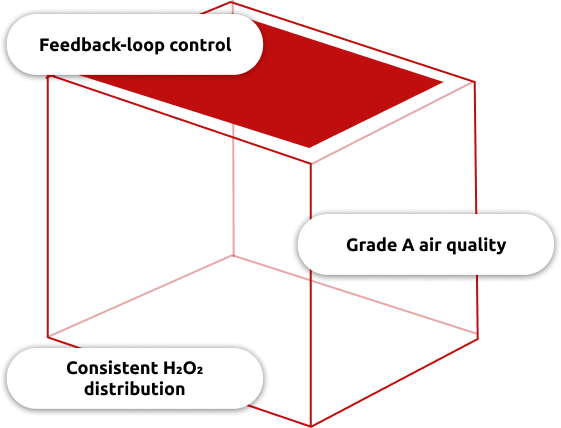

EVERY CRITICAL SURFACE EXPOSED
Load supports and trolley systems are engineered to minimize contact points and shadowed areas, enabling controlled H₂O₂ distribution around exposed surfaces.
HIGH THROUGHPUT UNDER GRADE A CONTROL
Large-capacity chambers, automatic loading and unloading, controlled airflow and continuous particle monitoring support high-volume material flows while maintaining Grade A conditions throughout processing and storage.
FREEDOM FROM PROPRIETARY CHEMISTRY
No proprietary peroxide solution is required. Customers retain control over the supplier and concentration of the aqueous H₂O₂ solution, reducing consumable dependency and operating constraints.
DEDICATED PROCESS CONTROL FUNCTIONS
The cycle governs four interconnected phases:
- Dehumidification: chamber conditions are prepared for controlled H₂O₂ distribution
- Conditioning: vaporized hydrogen peroxide is introduced until the defined concentration is reached
- Decontamination: the target concentration is maintained for the validated exposure time, achieving a 6-log reduction of surface bioburden
- Aeration: residual H₂O₂ is removed and monitored until the defined release threshold is reached, typically 1ppm
Cycle parameters are adapted to load quantity, material behaviour and absorption characteristics. The decontamination phase can be completed in approximately 30 minutes.
PRESTERILIZED COMPONENTS FOR ASEPTIC MANUFACTURING
Stopper bags, syringes, wrapped components and other presterilized materials can enter RABS, isolators and cleanrooms through a validated surface-decontamination process.
HIGH-THROUGHPUT ASEPTIC MANUFACTURING
Multiple-trolley capacity, automatic loading and unloading, and continuous particle monitoring support applications where material transfer must keep pace with production while maintaining Grade A conditions.
LARGE AND COMPLEX MATERIAL FLOWS
Custom-engineered chambers accommodate large loads and demanding transfer patterns, combining controlled H₂O₂ distribution with repeatable load positioning and automated handling.
HEAT-SENSITIVE PROCESS MATERIALS
Dry excipients, microbiological monitoring supplies and other non-autoclavable materials can be introduced into controlled areas without exposure to high temperatures.
Can the process accommodate different materials and loads?
Yes. H₂O₂ concentration, exposure time and aeration are adapted to load quantity, configuration, absorption behaviour and validation requirements.
Can the system support high-throughput production?
Yes. The technology can be engineered with large-capacity chambers, multiple-trolley configurations, automatic loading and unloading, continuous particle monitoring and Grade A storage conditions.
Is proprietary hydrogen peroxide required?
No. Customers can select the supplier and concentration of the aqueous H₂O₂ solution according to their operational requirements.
Why is direct H₂O₂ concentration measurement important?
The injected quantity alone does not demonstrate the concentration achieved around the load. Direct high- and low-range measurement allows the process to govern lethal exposure and confirm safe residual levels before release.
What microbiological reduction does the process achieve?
The process achieves a validated 6-log reduction of the initial bioburden on exposed load surfaces.
What does the Process Decontaminate?
The process achieves validated microbiological reduction on exposed load surfaces, creating a controlled entry route for heat-sensitive and presterilized materials entering aseptic environments.
DISCOVER CONNECTED SOLUTIONS
Explore related knowledge
Discover how our process knowledge connects technologies, applications and processes.