
Skip to content

RTU vials in nest

When manufacturers seek to move away from EtO towards a method that reduces toxic-residue concerns and the potential burden on patients, workers and the environment, selecting an alternative sterilant is only the beginning.

This is particularly true for the low-temperature sterilization of RTU glass vials in their complete packaging configuration. The sterilant must pass through the outer transport box, multiple porous barriers and enclosed packaging interfaces before reaching the internal vial surfaces. The same structure must then release residual sterilant within an acceptable aeration time.

Moving beyond EtO requires more than another sterilant. It requires a new understanding of the complete process.


Request more information

WE TRANSFORM THE ACTUAL RTU CONFIGURATION INTO AN OBSERVABLE PROCESS MODEL.

Critical quality attributes define what must be demonstrated, while biological indicators positioned across the packaging interfaces reveal how the sterilant progresses from the outer load to the vial interiors.

Deep-vacuum level, H₂O₂ delivery, pulse sequence and exposure are then evaluated as interacting parameters.

After each development cycle, biological effectiveness and residual levels are assessed, converting observed effects into the knowledge required to refine the next parameter combination.

The result is not simply a cycle that produces a successful outcome. It is a defined process supported by an understanding of the relationships between load architecture, critical process parameters and critical quality attributes.

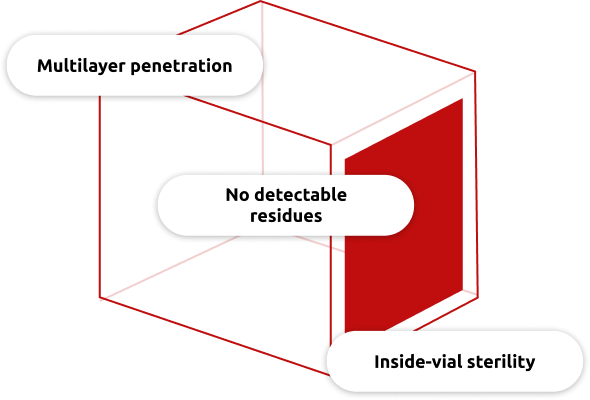
Diagram of key factors for RTU glass vial sterilization in nest: multilayer penetration, no detectable residues, and inside-vial sterility.

OUR APPROACH

1. DEFINE WHAT THE PROCESS MUST ACHIEVE

Development begins by translating the required outcome into measurable critical quality attributes.

Each attribute requires dedicated evidence: a successful biological result cannot replace residual analysis or product-integrity testing.

  • Biological effectiveness at the most difficult load locations
  • H₂O₂ residual control after aeration
  • Preservation of the relevant product and packaging attributes

2. MAP THE COMPLETE PENETRATION PATH

Biological indicators are positioned at critical interfaces throughout the actual load.

This arrangement does more than demonstrate final biological effectiveness.

It reveals how the sterilant progresses through the packaging configuration and helps identify where penetration becomes most challenging.

3. IDENTIFY THE GOVERNING PARAMETERS

Deep vacuum removes trapped air and opens access to enclosed spaces, while H₂O₂ injection pressure and dose govern sterilant delivery. Pulse sequence and holding time shape penetration and exposure at the critical locations. Aeration conditions then govern residual removal from the vials and packaging.

These parameters are evaluated together because changing one can influence biological effectiveness, residual removal and total cycle performance.

4. CONNECT PROCESS INPUTS TO QUALITY OUTCOMES

PROCESS INPUTS → OBSERVED LOAD BEHAVIOUR → QUALITY OUTCOMES

Each development cycle connects the selected parameter combination with the biological and chemical evidence generated throughout the load. Once the resulting process conditions are confirmed, the evidence identifies the load configuration, critical locations, controlled parameters and acceptance criteria required to support subsequent qualification and transfer.

FREQUENTLY ASKED QUESTIONS

Why can chamber measurements not demonstrate sterilization inside the vials?

Chamber measurements describe conditions outside the packaged load. They do not show whether trapped air has been removed from the internal configuration or whether sufficient sterilant has crossed every barrier. Evidence must therefore be generated at the critical locations inside the load.

Why does replacing EtO require a new process-development activity?

EtO and vH₂O₂ have different transport, exposure and residual-removal behaviours. A cycle developed for EtO cannot define how vH₂O₂ will penetrate the same packaging configuration. The alternative process must be developed around the actual load and its specific barriers.

Why are two methods used to assess residual H₂O₂?

The colorimetric method provides rapid feedback during process development. The more sensitive UV-Visible method supplies quantitative confirmation through a qualified external laboratory. Together, they support optimization and final evidence generation.

Why are biological indicators positioned at several packaging interfaces?

Distributed BI placement reveals how biological effectiveness develops along the penetration path. It helps distinguish an external entry limitation from a critical condition closer to the vial interiors and supports identification of the biological worst case.

Why must the critical process parameters be evaluated together?

Vacuum, H₂O₂ delivery, pulse sequence and holding time influence one another. A change that improves penetration may also affect residual removal or total cycle duration. Their combined effect, rather than any individual setpoint, determines process performance.

fedegari-solutions-sterilization-for-application-tecnology-packaging-1

THE CUBE HAS MORE THAN THREE FACES

Explore how Fedegari has approached sterile process challenges across different industries, applications and manufacturing environments.


WHITE PAPER AND RESEARCH

Technical depth, documented and made accessible. A growing collection of papers and research contributions developed from real application experience across industries, processes and manufacturing environment.

Customer so closer is not a promise of proximity
It is a way of working.

A global network designed to keep Fedegari close to the customer, close to the process and close to the decisions that make sterile manufacturing safer, more reliable and more valuable over time.