
Validated
washing
Pharmaceutical parts and components can carry viable microorganisms, particles and chemical residues, including endotoxins. As manufacturers move from operator-dependent manual washing to automated processes, the objective is not simply repeatable execution, but a demonstrated cleaning outcome across all three contamination classes.
Sterilization inactivates viable microorganisms: it does not remove particles, chemical residues or endotoxins. Sterility assurance therefore starts before sterilization: with a validated washing process.
EVERY PHARMACEUTICAL WASHING PROCESS IS GOVERNED BY TACT - TIME, MECHANICAL ACTION, CHEMISTRY AND TEMPERATURE.
Yet soil behaviour, component geometry, acceptance criteria and contamination risk determine whether the required outcome can be achieved through a pre-engineered configuration or requires dedicated process engineering.
Validation confidence through configuration where possible and customization where necessary.
We apply the right level of engineering: faster implementation for standard applications and purpose-designed control for complex ones.
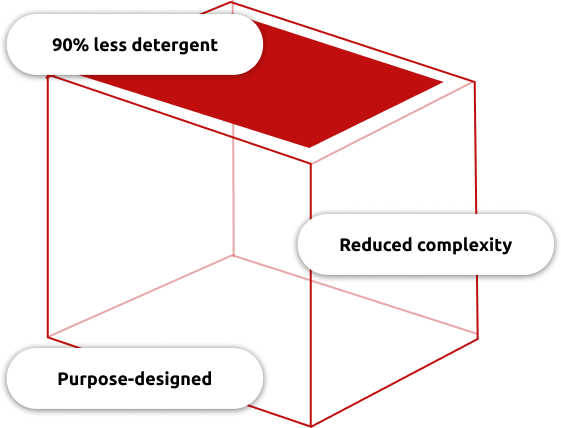

HIGHER LOAD CAPACITY WITHOUT HIGHER UTILITY PEAKS
A 30m³/h water pump and full coverage of rotating manifolds increase load capacity. Partialization of the same configuration limits instantaneous utility demand in a once-through mode, while standard cycles complete washing and drying in under one hour.
LOW INSTALLATION AND UTILITY REQUIREMENTS
The fully electric version requires no steam and operates with one or two water connections. Its compact 1 or 1.5m³ configuration reduces installation complexity in both new and existing facilities.
FAST DELIVERY AND LOW QUALIFICATION RISK
Pre-engineered modules, standardized software and pre-validated design documentation enable configurable Washer FAT within 4 to 5 months while reducing project and qualification uncertainty.
DEDICATED PROCESS CONTROL FUNCTIONS
Validation confidence and therefore repeatable washing depends on coordinated control of the hydraulic and mechanical actions throughout the cycle.
- Repeatable Hydraulic Execution: digital control coordinates pumps and valves across every cycle
- Controlled Phase Progression: sensor acquisition governs the transition between washing phases
- Washing Intensity Matched to the Process: inverter-driven actuators regulate the required washing action
- Repeatable Chemical Action: conductivity-based control delivers the defined detergent concentration across production cycles
CONFIGURABLE WASHING
Choose the Configurable Washer when components fit its predefined chamber sizes and pre-engineered process configuration. It is suited to manual-to-automated washing transitions where rapid delivery, limited customization, compact installation and reduced utility requirements are priorities.
FULL WASHING PERFORMANCE WITHIN AVAILABLE UTILITIES
Sectional manifold operation, recirculation and accumulation tanks align washing performance with available utility capacity. Where steam is unavailable, the fully electric version eliminates the need for steam infrastructure.
CUSTOMIZED WASHING
Choose Customized Washing when soil behaviour, load geometry, capacity, contamination risk or facility constraints require a purpose-designed process. Chamber dimensions, racks, hydraulics, flow strategy, heating and utility connections can be engineered around the application.
REDUCED CARRYOVER ACROSS MULTI-PRODUCT OPERATIONS
Once-through washing uses fresh process solution rather than recirculation, reducing carryover between products and simplifying the cleaning-validation strategy.
UNINTERRUPTED FULL-TROLLEY FLOW
Custom full-height, pit-mounted installations allow complete trolleys to pass through the chamber while preserving the required material flow and separation between production areas.
When should I choose configurable rather than customized washing?
Choose configurable washing when the application fits a pre-engineered configuration. Choose customized washing when process complexity requires dedicated engineering.
Why replace manual washing with an automated process?
Automated washing reduces operator dependency by reproducing defined cycle conditions and load configurations. It provides documented evidence that supports the validated removal of viable contamination, particles and chemical residues.
Is an automatic washing process already validated?
No. Automation provides a controlled platform, but cleaning validation remains specific to the soil, components, load, cycle and manufacturing site. Pre-validated design documentation can reduce qualification effort without replacing application-specific validation.
When should once-through washing be considered?
Once-through processing is relevant when avoiding solution recirculation can reduce carryover risk between products. It may simplify the cleaning-validation strategy, but it does not eliminate the need for validation.
How does clean steam support washing?
Direct clean-steam injection transfers heat through condensation and can soften suitable soils before washing. Its use must reflect soil behaviour, since some residues benefit from thermal conditioning while others require detergent action before heating.
How is detergent dosing controlled?
During initial setup, the required detergent concentration is associated with a conductivity value. The system uses this value to control repeatable dosing during production cycles. Conductivity controls dosing, not the final-rinse endpoint.
DISCOVER CONNECTED SOLUTIONS
Explore related knowledge
Discover how our process knowledge connects technologies, applications and processes.
What if the quality of your sterile product depends on something as simple as complex as the way you clean?
In pharmaceutical manufacturing, washing is a silent yet decisive process step, one that often determines whether sterility can truly be achieved
