
Glass vials
The rapid growth of biologics, nanoparticle-based medicines and Advanced Therapy Medicinal Products (ATMPs) is redefining the relationship between pharmaceutical formulations and primary packaging.
Interactions between proteins such as insulin, nanoparticles and container surfaces are well-recognised phenomena that can influence product stability, efficacy and patient safety. As these therapies become increasingly sensitive, material compatibility can no longer be considered an intrinsic property of the container alone.
Before a drug product is ever filled, glass vials undergo washing, depyrogenation and steam sterilization. These manufacturing processes progressively transform the material surface, influencing how it will ultimately interact with the formulation.
GLASS VIAL BEHAVIOUR IS A PROCESS OUTCOME
Material behaviour of a glass vail is not an intrinsic property: it is progressively defined by the manufacturing process.
During washing, depyrogenation and steam sterilization, glass surfaces undergo thermal, mechanical and chemical stresses that modify their physical and chemical characteristics. These transformations influence how the packaging will interact with increasingly sensitive pharmaceutical formulations.
Equivalent sterilization does not mean equivalent material behaviour
Sterilization cycles delivering the same microbiological lethality (F₀) can generate different surface characteristics depending on the process conditions. Sterility may be equivalent, while material behaviour is not.
Material evolution is cumulative throughout sterile manufacturing
Surface properties are not determined by a single process step. They are progressively shaped by the combined effects of washing, depyrogenation and steam sterilization.
Material behaviour influences formulation behaviour
Changes in surface characteristics influence interactions with proteins and lipid nanoparticles, affecting adsorption phenomena and the behaviour of highly sensitive pharmaceutical formulations.
WHY FEDEGARI KNOWS
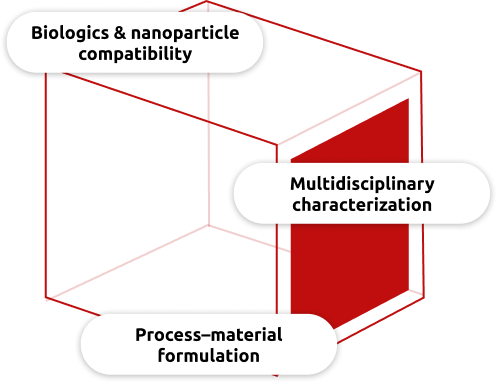
Our understanding of material behaviour begins with governing the manufacturing sequence that prepares primary packaging for aseptic production. Throughout washing, depyrogenation and steam sterilization, materials are exposed to thermal, mechanical and chemical stresses that progressively define the surface the drug product will ultimately encounter.
We connect process behaviour, material evolution and formulation performance to understand how manufacturing history transforms material behaviour and, in turn, influences product performance.
This multidisciplinary research approach follows the complete cause-and-effect relationship.
SURFACE EVOLUTION
Each process condition was correlated with measurable changes in surface SEM morphology, AFT topography, nanomechanical properties and surface zeta potential, allowing material evolution to be objectively characterised.
FORMULATION BEHAVIOUR
Surface evolution was correlated with the behaviour of representative pharmaceutical formulations to understand how material changes influence product performance.
Interaction studies using model proteins and Solid Lipid Nanoparticles (SLN) revealed measurable adsorption phenomena and correlations between surface properties, including roughness and isoelectric point, as well as formulation behaviour.
This research represents the foundation of our understanding of how sterile manufacturing defines material behaviour.

emerge sterile, dry and ready for immediate use.
Why are biologics and nanoparticle formulations more sensitive to surface interactions?
Proteins and nanoparticle-based formulations are particularly susceptible to adsorption and aggregation phenomena. Even small changes in surface properties can influence formulation behaviour and long-term stability.
Why do washing and depyrogenation matter?
Material surfaces evolve throughout the entire preparation sequence. Washing, depyrogenation and steam sterilization each contribute to defining the final state of the packaging before filling.
How can material behaviour be characterised?
A multidisciplinary approach combining surface morphology, topography, nanomechanics and surface charge allows material evolution to be correlated with pharmaceutical formulation behaviour under representative manufacturing conditions.
Why isn't equivalent F₀ enough to guarantee equivalent material behaviour?
Equivalent F₀ demonstrates equivalent microbiological lethality, but different temperature profiles and process conditions can produce different surface characteristics. Sterility may therefore be equivalent while material behaviour is not.
Why is this knowledge becoming increasingly important?
As pharmaceutical products become more complex, understanding how sterile manufacturing shapes material behaviour is becoming an essential part of designing predictable, repeatable and robust aseptic manufacturing processes.