
Solutions for sterile powder manufacturing
Sterile powder manufacturing presents one of the most demanding combinations of aseptic processing and high-containment production.
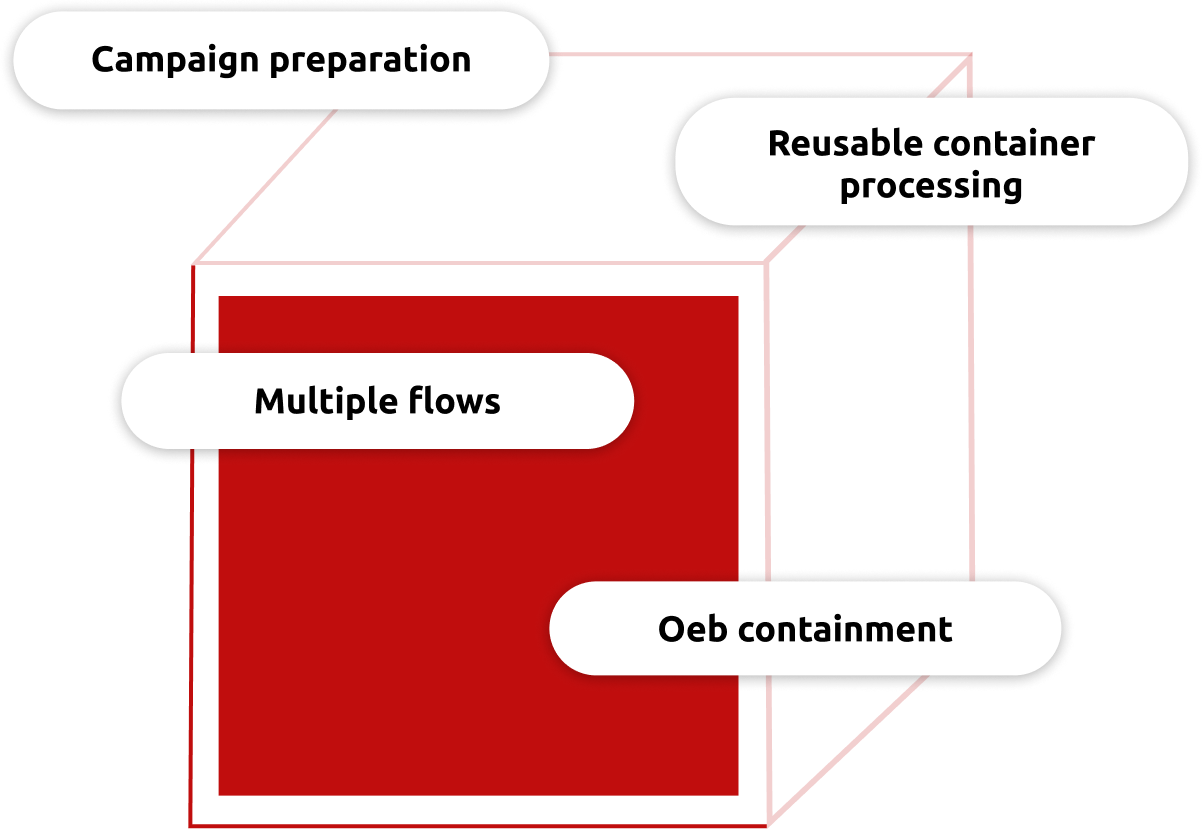
Reusable containers, machine parts and thermosensitive materials must each follow dedicated preparation pathways before entering the filling environment, while uninterrupted production campaigns require a sufficient number of sterile containers to be available before filling can even begin.
The challenge therefore extends well beyond aseptic filling itself: manufacturers must coordinate washing, depyrogenation, sterilization, material bio-decontamination, protected transfers and containment into a single validated manufacturing workflow that preserves both product sterility and operator safety.
30 kegs/washing batch
maximum number of aluminium kegs prepared during a single washing cycle before downstream depyrogenation
60
sterile kegs buffer accumulated inside the RABS before the filling campaign begins, ensuring uninterrupted production
OEB 5
contained filling performed under high-containment conditions to protect operators during sterile powder processing
≈1 h
customized washing cycle
EVERY TRANSITION IS PART OF THE STERILE PROCESS
Sterility is not established by a single technology but preserved through every transition between preparation, transfer, filling and packaging.
We design each interface between washing, depyrogenation, sterilization, bio-decontamination, automated handling and barrier systems as part of one controlled manufacturing workflow, transforming multiple independent operations into a repeatable sterile production campaign.
Preparing sterile primary containers: After washing, aluminium kegs undergo dry-heat depyrogenation before entering the protected RABS, providing sterile and pyrogen-controlled containers for powder filling.
Aluminium kegs are washed before depyrogenation to remove manufacturing residues and prepare every container for the downstream aseptic production campaign.
Thermosensitive production materials enter the Grade B environment through hydrogen peroxide pass boxes, preserving aseptic conditions without thermal exposure.
Reusable machine parts are washed before sterilization to remove process residues and prepare the filling line for the next manufacturing campaign.
Depyrogenated kegs are transferred individually into the contained filling isolator, where sterile powder filling, stoppering, crimping and primary bagging are performed under OEB 5 containment.
Washed machine parts are sterilized before installation, ensuring sterile contact surfaces throughout the aseptic filling process.
A Grade A RABS provides sterile parking for depyrogenated kegs before their controlled transfer into the contained filling isolator, supporting uninterrupted production campaigns.

emerge sterile, dry and ready for immediate use.
Why are reusable machine parts and aluminium kegs treated separately?
They have different process objectives. Machine parts require washing followed by terminal steam sterilization before line assembly, while aluminium kegs undergo washing followed by dry-heat depyrogenation before entering the aseptic production flow.
Why must sterile kegs be prepared before the filling campaign starts?
Continuous powder filling cannot be interrupted. A sufficient number of washed and depyrogenated kegs must therefore be accumulated inside the Grade A RABS before production begins, ensuring a continuous supply of sterile containers throughout the manufacturing campaign.
Why is dry-heat depyrogenation used for aluminium kegs?
Dry-heat depyrogenation prepares reusable primary containers by combining sterilization with endotoxin reduction before direct contact with sterile powder products.
How are thermosensitive materials introduced into the production area?
Materials that cannot withstand thermal treatment are transferred through validated hydrogen peroxide pass boxes before entering the classified production environment..
Why is process integration critical for sterile powder manufacturing?
Because product sterility and operator protection depend on every transition between cleaning, sterilization, depyrogenation, material transfer and filling—not on any single technology alone.
Why is a RABS used before the contained filling isolator?
The Grade A RABS acts as a sterile parking area where depyrogenated kegs are accumulated before controlled transfer into the filling isolator, supporting uninterrupted production campaigns.