
Solutions for
albumin pasteurization
Albumin is a heat-sensitive biological product. Once prepared, purified, formulated and stabilized, it is sterile-filtered and aseptically filled into final glass vials or bottles. Since it cannot be subjected to a conventional terminal sterilization at 121°C, the filled and sealed containers undergo validated pasteurization at 60°C for at least 10 hours to support viral inactivation while preserving protein stability and product quality.
Albumin pasteurization is traditionally performed in water-bath systems. Although effective for heat transfer, this established approach requires very large quantities of process water, increasing utility consumption, wastewater generation and operating costs across a long and production-critical treatment.
AVOIDING THE WATER BATH
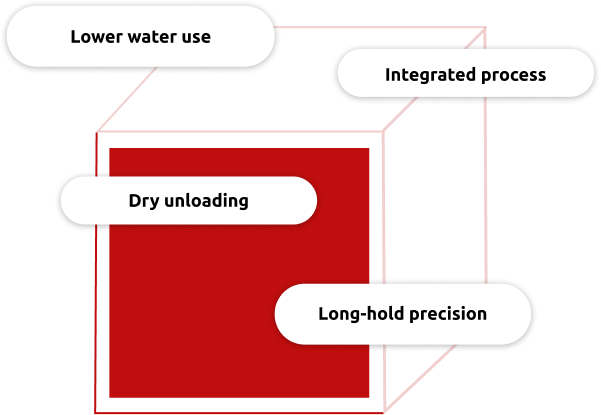
We replace immersion in large volumes of water with an air/steam pasteurization cycle developed for the specific requirements of albumin.
Independent control of temperature and chamber pressure, continuous regulation of the steam-air mixture and advanced ventilation maintain the complete load at 60°C within ±0.5°C throughout the holding phase of at least 10 hours. Homogeneous circulation limits temperature stratification and overshoot, supporting repeatable heating, holding and cooling profiles. As containers are neither immersed nor sprayed, the process substantially reduces water consumption and allows the product to leave the chamber dry.
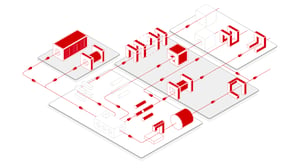
The solution can also integrate automatic loading and unloading, as well as upstream washing and steam sterilization, or combined washing and sterilization, of filling-line parts. Tech Center testing develops the cycle around the actual formulation, container, fill volume and load configuration.
Steam sterilization for compatible reusable parts packaged in bags or canisters before protected or closed transfer.
Precise regulation and homogeneous circulation maintain the complete load at 60°C within ±0.5°C throughout the holding phase of at least 10 hours substantially reducing water consumption.
Reusable heat-sensitive parts whose material, geometry, packaging and microbial-reduction requirements support a validated low-temperature route.
Sealed RTU or pre-sterilized materials whose internal sterile state must be preserved while the outer packaging is treated before entry.
Compact layouts, fewer equipment interfaces, reduced classified-space demand or a single integrated route for compatible reusable loads.
Integrated washing and sterilization of bulk closures, followed by closed transfer in a sterile tank.
Reduced exposure, controlled connection to the barrier and readiness for closed or robotic reassembly..
Validated washing establishes the required cleanliness state for reusable product-contact, machine and format parts before downstream treatment.
Maintains treated bulk stoppers within a closed sterile environment during transfer from the washing and sterilization system to the automated manipulator.
Controlled loading, unloading, movement, connection and delivery to reduce exposure and avoidable manual intervention.
Controlled recirculation showers containers with temperature-conditioned water, enabling direct heat transfer, rapid equilibration and uniform maintenance of the required 60°C condition across the load.

emerge sterile, dry and ready for immediate use.
Why choose air/steam pasteurization instead of a conventional water bath?
Air/steam offers an alternative that avoids immersing or spraying the containers. This substantially reduces process-water consumption and wastewater generation while allowing the load to leave the chamber dry. Precise regulation of temperature, chamber pressure and steam-air circulation maintains the required 60°C condition across the load throughout the extended holding phase.
Why is albumin pasteurized rather than terminally sterilized at 121°C?
Albumin is a heat-sensitive biological product. Filled and sealed containers undergo pasteurization at 60°C for at least 10 hours to support viral inactivation while preserving protein stability and product quality, rather than undergoing conventional terminal sterilization at 121°C.
Why is air/steam control particularly demanding at 60°C?
At this relatively low operating temperature, variations in chamber pressure or the steam-air mixture can affect temperature distribution. Precise regulation and homogeneous circulation are therefore required throughout heating, holding and cooling to maintain the complete load within the specified temperature range.
How does air/steam technology reduce water consumption?
Unlike a conventional water-bath process, the air/steam cycle does not require the load to be immersed in large volumes of water. Containers are also not sprayed during processing, substantially reducing process-water demand and the associated wastewater compared with water-bath systems.
How is consistent thermal exposure supported across the load?
Independent control of temperature and chamber pressure is combined with continuous regulation of the steam-air mixture and advanced ventilation. These functions support homogeneous circulation, limit stratification and overshoot, and deliver repeatable heating, holding and cooling profiles across the load.
What must be considered during process development?
Development considers the albumin formulation, stabilizers, container format, filling volume, load configuration, temperature tolerance, pressure sensitivity and heating and cooling behaviour. Production capacity and facility layout are also evaluated when defining the final equipment and cycle configuration.
Explore related knowledge
Discover how our process knowledge connects technologies, applications and processes.