
Aseptic transfer
Aseptic manufacturing depends on preserving the required state of every material until its point of use. Yet reusable parts, pre-sterilized components, bulk closures, tools and auxiliary materials enter the process from different conditions, through different routes and with different vulnerabilities.
Treatment alone does not secure the flow: unloading, transport, storage, manipulation and connection create critical interfaces where control can be lost. As manufacturing architectures become more closed, integrated and automated, aseptic transfer becomes a system-level responsibility.
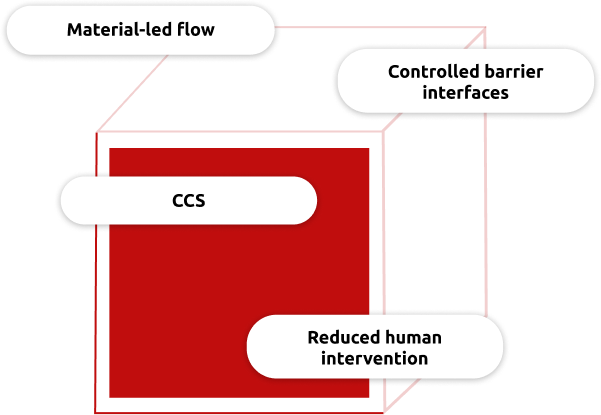
Every material flow requires a defined target state, a compatible treatment, a protective barrier, a controlled transfer method and an engineered interface with the aseptic processing environment.
0
open transitions preserve the sterile boundary from treatment to point of use without environmental exposure
3
core material routes: reusable product-contact parts, pre-sterilized RTU components and stoppers
3
contamination risks controlled: microbial, particulate and endotoxin contamination
STERILIZATION BY DESIGN
means governing the complete transfer architecture.
Reusable product-contact components, machine and format parts, tools and auxiliary materials, pre-sterilized components, thermosensitive materials, and bulk closures, for each flow, we define the cleanliness, sterility and protection state required at the point of use, select the treatment compatible with the material and its packaging, and establish how that state remains protected throughout unloading, transport, storage and manipulation.
We determine how each material crosses the aseptic barrier, how it interfaces with the isolator, RABS or filling line, and which manual interventions must be eliminated. We do not start from a machine. We start from every material entering the aseptic process and control its complete route to the point of use.
Aseptic transfer is not one technology. It is the controlled orchestration of every material flow into the aseptic process.
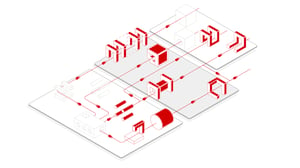
Reduced exposure, controlled connection to the barrier and readiness for closed or robotic reassembly.
Maintains treated bulk stoppers within a closed sterile environment during transfer from the washing and sterilization system to the automated manipulator.
Controlled loading, unloading, movement, connection and delivery to reduce exposure and avoidable manual intervention.
Steam sterilization for compatible reusable parts packaged in bags or canisters before protected or closed transfer.
Integrated washing and sterilization of bulk closures, followed by closed transfer in a sterile tank.
Reusable heat-sensitive parts whose material, geometry, packaging and microbial-reduction requirements support a validated low-temperature route.
Sealed RTU or pre-sterilized materials whose internal sterile state must be preserved while the outer packaging is treated before entry.
Compact layouts, fewer equipment interfaces, reduced classified-space demand or a single integrated route for compatible reusable loads.
Validated washing establishes the required cleanliness state for reusable product-contact, machine and format parts before downstream treatment.

emerge sterile, dry and ready for immediate use.
What is the difference between low-temperature sterilization and surface decontamination?
Low-temperature sterilization establishes the validated microbial-reduction state required for a compatible load. Surface decontamination treats the exterior of sealed pre-sterilized packaging before entry; it does not re-sterilize the component inside.
Why is there no single standard aseptic-transfer route?
Materials enter from different initial conditions and must reach different target states. Heat resistance, packaging, geometry, sterility status, barrier configuration and handling needs determine the correct treatment and transfer architecture.
What does aseptic transfer include?
Aseptic transfer includes the complete route that takes a material from its initial state to its point of use: preparation, treatment, packaging or containment, unloading, movement, storage, barrier crossing, connection and final handling.
Where does automation add the greatest value?
Automation adds value where loading, unloading, movement, alignment, connection or assembly would otherwise create repeated manual interventions. It strengthens repeatability and reduces exposure while remaining integrated with the treatment and barrier strategy.
Can washing and sterilization be integrated?
Yes. Compatible reusable parts can follow a combined washing-and-sterilization route in one platform. This reduces equipment interfaces and supports compact layouts; load preparation and protected downstream transfer remain part of the overall architecture.
How are Tyvek® bags and canisters selected?
The Grade A RABS acts as a sterile parking area where depyrogenated kegs are accumulated before controlled transfer into the filling isolator, supporting uninterrupted production campaigns.
Explore related knowledge
Discover how our process knowledge connects technologies, applications and processes.
Aseptic Transfer: the fragile points of sterility
Where process design determines whether sterility holds - or fails
.jpg?width=300&name=fedegari_group_aseptic-transfer-the-fragile-points-of-sterility%20(1).jpg)
Closer to customers is not a promise of proximity.
It is a way of working.
A global network designed to keep Fedegari close to the customer, close to the process and close to the decisions that make sterile manufacturing safer, more reliable and more valuable over time.