
Steam sterilization of machine parts in Tyvek® bags
Tyvek® bags provide a sterile barrier while allowing steam penetration, but processing machine parts inside porous packaging — particularly in double-bag configurations — introduces challenges that cannot be managed by temperature alone.
Irregular geometries, different thermal masses, folds, overlapping surfaces and contact with the trays influence air removal, steam circulation and condensate evacuation. At the same time, rapid pressure changes can mechanically stress the bags, while poorly controlled depressurization can cool the load and make drying more difficult.
High-density loading can further restrict vapor flow and create localized areas where moisture remains trapped.
The objective is therefore not simply to sterilize the load, but to unload machine parts sterile and dry, with the integrity of bags and seals preserved.
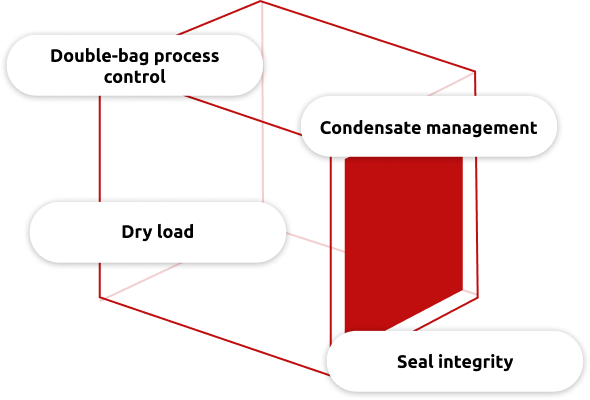
For machine parts enclosed in Tyvek® bags, extending the final vacuum cannot compensate for insufficient preheating, uncontrolled condensate formation, excessive pressure gradients or an unsuitable load arrangement.
We develop the complete bag–load–autoclave system so that steam can penetrate double-bag configurations, condensate can be effectively removed and packaging integrity can be preserved throughout the cycle.
When a dry load is not achieved, we know how to identify whether the cause lies in the cycle recipe, the load configuration or the autoclave itself — and intervene at its source.
We do not simply compensate for process imbalance with a longer cycle. We identify and address its cause.
KNOWLEDGE IS THE CORE OF EVERY SUCCESSFUL PROCESS
For more than 70 years, Fedegari has been developing sterilization processes for pharmaceutical manufacturing. Today, over 4,000 Fedegari autoclaves are operating worldwide, continuously expanding our knowledge of how different loads and packaging configurations behave under real production conditions.
This experience allows us to look beyond the standard cycle recipe. We understand the interactions between the machine parts, the bags, the load arrangement, the autoclave and the process — and recognize whether a critical outcome depends on cycle development, loading practices or equipment configuration.
We transform this accumulated knowledge into a process developed for the actual application, with one clear target: sterile machine parts, a dry load and preserved bag and seal integrity.

emerge sterile, dry and ready for immediate use.
Why can Tyvek® bags be damaged during steam sterilization?
Steep pressure gradients can create mechanical stress across the packaging. Controlled and progressive depressurization helps protect bag and seal integrity while preserving the thermal conditions required for effective moisture removal.
Does the arrangement of the bags affect process performance?
Yes. Bag inclination, folds, overlapping surfaces, tray position and the weight of the enclosed components can create localized thermal and mass-transfer differences. Load configuration must therefore be developed as part of the sterilization process.
Can a longer vacuum phase guarantee a dry load?
Not necessarily. If the load cools excessively, bags overlap or the autoclave cannot effectively evacuate condensate, simply extending the vacuum may increase cycle time without achieving complete dryness.
Why can condensate remain inside or between Tyvek® bags?
Condensate can become trapped in folds, beneath heavy components or between overlapping bag surfaces. These contact areas restrict vapor circulation and reduce the surface available for evaporation during the drying phases.
Where should temperature probes be positioned?
Probes should be placed inside representative bags and at the most thermally challenging locations of the load. Measurements taken only close to the chamber walls may not represent the actual cold spots within the packaged components.