
Stopper
in bulk
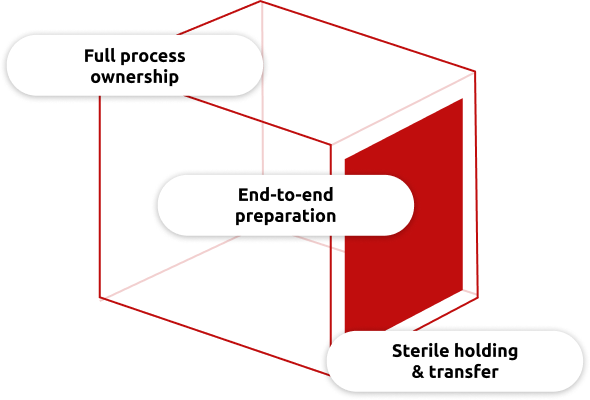
Internalizing bulk stopper preparation means directly assuming technical responsibility and controlling all critical quality variables before aseptic filling.
While ready-to-use (RTU) stoppers transfer preparation upstream to suppliers, handling bulk stoppers internally allows manufacturers to actively govern particulate, pyrogenic, microbiological, and physical condition, right up to the filling line, achieving consistent process performance and robust quality outcomes.
- Washing sets the conditions for effective endotoxin removal and supports all subsequent phases
- Sterilization ensures robust, repeatable microbial control
- Drying secures the physical state for optimal downstream handling
- Transfer safeguards the achieved quality until the moment of use
Our continuous process integrity enhances auditability, minimizes manufacturing risk, and secures regulatory compliance, consistently delivering up to 3-log endotoxin reduction, extremely low residual humidity (down to 0.05% GRAV) and full process readiness in about 5–6 hours.
CONTAMINANT REMOVAL
Complete immersion, gentle drum rotation, progressive washing phases, overflow removal of floating contaminants and final once-through rinsing progressively eliminate both heavy and light contaminants while preserving closure integrity. The process achieves up to 3-log endotoxin reduction before sterilization.
UNIFORM EXPOSURE
Our sterilization cycle combines steam pulses with continuous low-speed redistribution of individual stoppers. By continuously changing stopper orientation, the process maximizes steam contact, promotes condensate removal and ensures repeatable sterilization conditions across the entire load. The result: stable, repeatable microbial control, far beyond conventional tilting processes.
DRYNESS
Alternating vacuum, reheating with hot sterile filtered air and controlled cooling progressively remove residual moisture while preparing the load for aseptic transfer. The process achieves residual humidity as low as 0.03% (GRAV), ensuring the physical condition required for downstream manufacturing.
STERILITY MAINTENANCE
Preparation is complete only when the manufactured quality reaches aseptic manufacturing unchanged. Closures are therefore transferred into a dedicated sterile maintenance environment, preserving their microbiological and physical condition until RTP connection with the filling line.

emerge sterile, dry and ready for immediate use.
Why should washing, sterilization, drying and transfer be considered one process?
Each preparation cycle establishes the conditions required for the next one. Process robustness depends on the continuity between these phases rather than on optimizing each operation independently.
Why choose bulk stoppers instead of RTU components?
Bulk stopper preparation allows manufacturers to internalize one of the most critical preparation processes in aseptic manufacturing, increasing process ownership, flexibility and supply independence.
Why is endotoxin reduction achieved before sterilization?
Steam sterilization inactivates microorganisms but does not remove endotoxins. Effective pyrogen reduction must therefore be achieved during the washing process before sterilization begins.
Why is residual humidity important?
Residual humidity defines the physical condition in which the stopper enters aseptic manufacturing. Controlling it improves process repeatability and supports moisture-sensitive pharmaceutical manufacturing.
How is residual humidity measured?
Residual humidity is determined using the GRAV gravimetric method, measuring the weight loss of representative stopper samples after controlled heating until constant weight is achieved.
DISCOVER CONNECTED SOLUTIONS
Explore related knowledge
Discover how our process knowledge connects technologies, applications and processes.
Aseptic Transfer: the fragile points of sterility.
Where process design determines whether sterility holds - or fails
.jpg?width=300&name=fedegari_group_aseptic-transfer-the-fragile-points-of-sterility%20(1).jpg)