

Skip to content

Sterilization of
RTP canisters for aseptic transfer

In modern aseptic manufacturing, RTP canisters are increasingly used to transfer product-contact parts and filling assemblies into Grade A isolators.

Their adoption supports a closed contamination control strategy, reduces operator intervention, and helps maintain sterility from preparation through point of use.
However, canisters introduce a unique challenge. Air removal, steam penetration, condensate management and drying must all be governed within an enclosed system where the sterile barrier itself becomes part of the sterilization process.

This is why successful canister sterilization depends on more than equipment. It depends on deep understanding of sterilization principles.

Request more information

CANISTER MAGNIFY EVERY WEAKNESS OF A STREAM STERILIZATION PROCESS.

Achieving sterility is only part of the challenge. Components must also remain protected, dry and ready for aseptic transfer. 

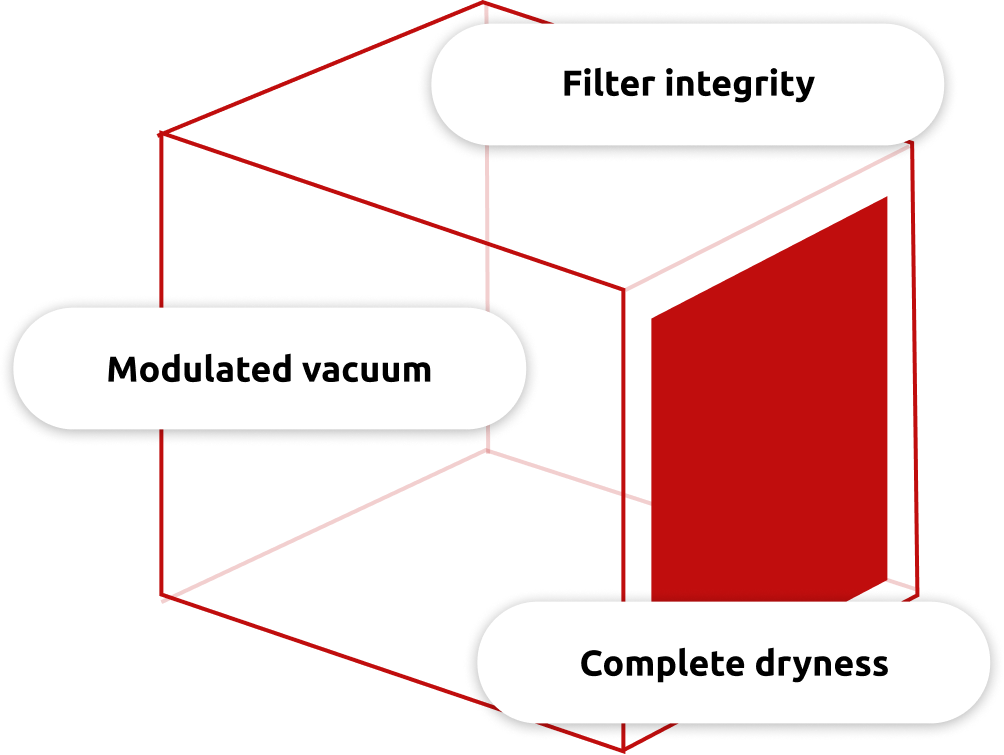
Filter integrity 
The filter is the functional element of the sterile barrier system. Its integrity must be preserved throughout sterilization, storage and transfer. 

Complete dryness 
In canister sterilization, condensate management is often more challenging than microbial inactivation itself, as residual moisture can compromise transfer readiness and affect process robustness. 

Uniform steam penetration 
Canisters frequently contain complex assemblies, filling systems, single-use components and long small-lumen tubing, creating critical challenges for air removal and steam penetration. 

We are designed to govern these objectives simultaneously, preserving sterility, filter integrity, dryness and transfer readiness throughout the process.

Diagram of key factors for canister steam sterilization: filter integrity, modulated vacuum, and complete dryness for pharma component processing

CYCLE DESIGN STARTS FROM CANISTER PHYSICS

Canisters do not create new sterilization challenges. They make existing ones impossible to ignore.

The defining characteristic of a canister is that steam inlet and air outlet correspond to the same element: the filter.
Air removal, steam admission, condensate evacuation and pressure release therefore occur through the same pathway, directly influencing both sterilization effectiveness and sterile barrier integrity.

The cycle must therefore be designed around the behavior of the canister, not around generic sterilization recipes.

canister-fedegari-packakging

MODULATED VACUUM AS A PROCESS TOOL

In standard steam sterilization cycles, vacuum is primarily used for air removal and drying. In canister sterilization, vacuum becomes a critical process parameter.

An aggressive vacuum profile may stress the filter and affect sterile barrier integrity. An insufficient vacuum profile may compromise air removal and drying performance.

Vacuum must therefore balance air removal, condensate evaporation and filter protection to ensure that sterility is preserved beyond the sterilization cycle and throughout transfer.

VALIDATION UNDER WORST-CASE CONDITIONS

Validation is not demonstrated under ideal conditions.

Biological indicators and temperature sensors are intentionally positioned in locations where steam penetration is most difficult and process complexity is greatest. Sterility, dryness and temperature uniformity are demonstrated under these conditions before the cycle is considered validated

FREQUENTLY ASKED QUESTIONS

Why is filter integrity considered part of sterilization 
validation?

In RTP canisters, the filter is not simply a venting device. It acts as the microbial barrier that preserves sterility after the cycle and during transfer.

For this reason, sterilization validation must demonstrate not only lethality, but also the ability to maintain filter integrity throughout air removal, steam exposure, drying and pressure transitions.

How do you verify sterilization effectiveness in complex 
canister loads?

Sterilization effectiveness is verified using biological indicators positioned in the most difficult locations to sterilize.
For filling systems connected through long small-lumen tubing, biological indicators were placed at mid-length positions and at the furthest locations from steam entry to challenge both air removal and steam penetration.
In validation studies, all biological indicators showed no growth after 7 days of incubation at 55°C, confirming sterilization effectiveness under worst-case conditions.

How is steam distribution verified inside RTP canisters?

Steam distribution is verified through temperature mapping performed in worst-case locations throughout the canister and its contents.
In validation studies involving RTP canisters and filling assemblies, Fedegari achieved a temperature differential of only 0.04°C during the exposure phase, demonstrating highly uniform steam distribution throughout the load.

Why are filling systems with long small-lumen tubing 
considered a worst-case load?

Long small-lumen tubing creates one of the most challenging geometries for steam sterilization because residual air can remain trapped and prevent saturated steam from reaching internal surfaces.

For this reason, filling tanks connected through small-lumen tubing are commonly used as worst-case configurations during cycle development, providing a robust challenge for both air removal and steam penetration.

Why is modulated vacuum important for RTP canister 
sterilization?

In RTP canisters, the filter is part of the sterile barrier system.
Vacuum must therefore perform two functions simultaneously: support air removal and drying while protecting filter integrity.

For this reason, Fedegari applies controlled and modulated vacuum phases specifically designed to avoid excessive mechanical stress on the filter while maintaining sterilization performance.

fedegari-solutions-sterilization-for-application-tecnology-packaging-1

THE CUBE HAS MORE THAN THREE FACES

Explore how Fedegari has approached sterile process challenges across different industries, applications and manufacturing environments.


WHITE PAPER AND RESEARCH

Technical depth, documented and made accessible. A growing collection of papers and research contributions developed from real application experience across industries, processes and manufacturing environment.

Customer so closer is not a promise of proximity
It is a way of working.

A global network designed to keep Fedegari close to the customer, close to the process and close to the decisions that make sterile manufacturing safer, more reliable and more valuable over time.