
High-potent
aseptic manufacturing
High-potent sterile manufacturing is one of the fastest-growing pharmaceutical sectors, driven by oncology biologics, antibody-drug conjugates (ADCs), peptides and other highly active compounds. While aseptic filling remains essential, manufacturers must simultaneously protect product sterility, operators and the surrounding environment. As occupational exposure limits decrease to the ng/m³ range, every reusable machine component leaving the filling isolator becomes a potential contamination source.
Containment therefore extends beyond the filling line and requires a manufacturing flow that integrates washing, decontamination, sterilization and controlled transfer as part of the overall Contamination Control Strategy.
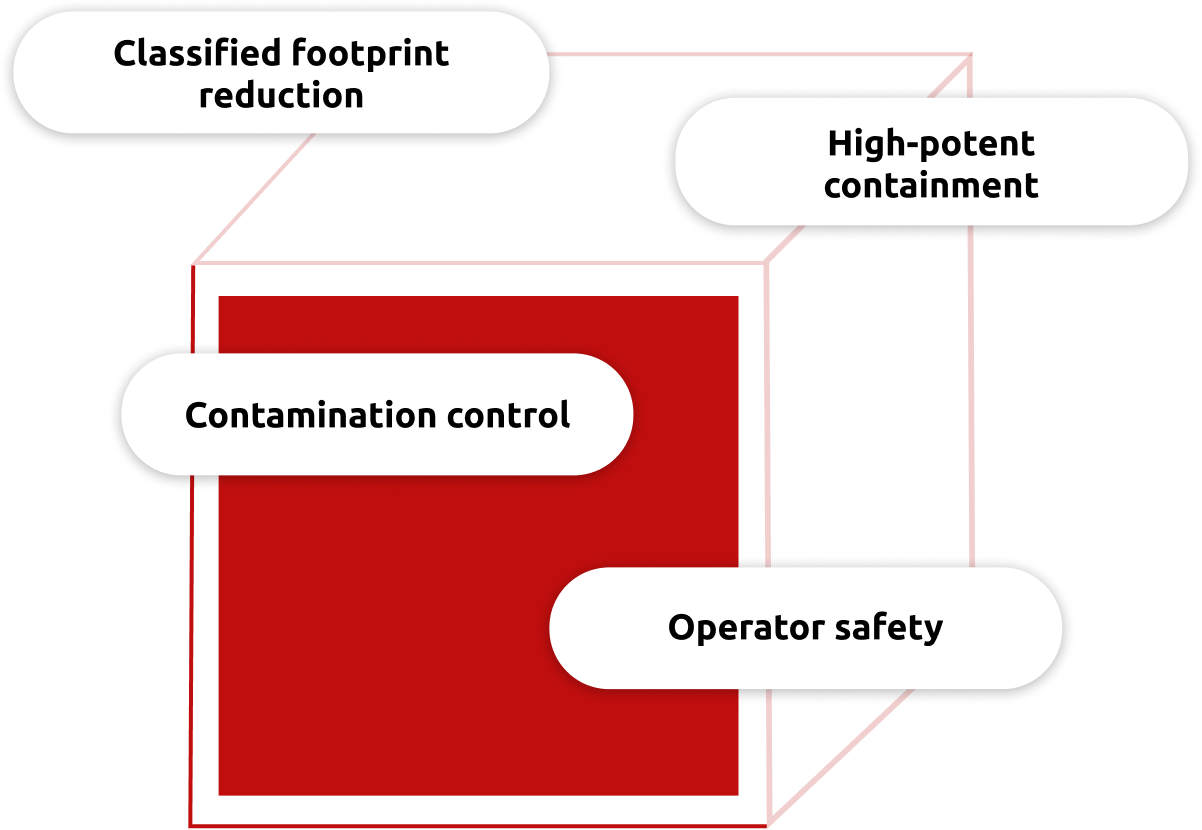
CONTAINMENT DOES NOT END AT THE FILLING MACHINE
We engineer the complete post-filling pathway for reusable components exposed to high-potent products.
Instead of treating washing, decontamination and sterilization as independent operations, we design a validated manufacturing flow that safely returns contaminated components to production while protecting operators, classified areas and product quality.
Depending on the manufacturing strategy, reusable components can follow two validated pathways. The standard one combines automated washing with biological decontamination before sterilization.
Where operator safety, reduced classified footprint and simplified material flow are priorities, we integrate washing and steam sterilization in a single pass-through system, restoring the required cleanliness and sterility conditions while minimizing handling and intermediate transfers.
Steam sterilization for compatible reusable parts packaged in bags or canisters before protected or closed transfer.
Controlled loading, unloading, movement, connection and delivery to reduce exposure and avoidable manual intervention.
Compact layouts, fewer equipment interfaces, reduced classified-space demand or a single integrated route for compatible reusable loads.
Reusable heat-sensitive parts whose material, geometry, packaging and microbial-reduction requirements support a validated low-temperature route.
Sealed RTU or pre-sterilized materials whose internal sterile state must be preserved while the outer packaging is treated before entry.
Integrated washing and sterilization of bulk closures, followed by closed transfer in a sterile tank.
Reduced exposure, controlled connection to the barrier and readiness for closed or robotic reassembly.
Validated washing establishes the required cleanliness state for reusable product-contact, machine and format parts before downstream treatment.
Maintains treated bulk stoppers within a closed sterile environment during transfer from the washing and sterilization system to the automated manipulator.
Automated validated washing removes product residues from reusable machine parts while reducing manual handling and supporting cleaning validation before subsequent processing.
Where biological decontamination is required, validated H₂O₂ treatment reduces contamination before components leave the contained manufacturing flow.
Sealed RTU or pre-sterilized materials whose internal sterile state must be preserved while the outer packaging is treated before entry.
Steam sterilization for compatible reusable parts packaged in bags or canisters before protected or closed transfer.

emerge sterile, dry and ready for immediate use.
Why does containment need to continue beyond the filling isolator?
Because reusable filling-line parts may retain high-potent product residues after production. Once they leave the barrier system, they can become a contamination pathway for operators, adjacent rooms and subsequent manufacturing activities. The return flow must therefore be included in the facility Contamination Control Strategy.
What is the standard route for treating contaminated components?
The standard configuration uses an automated parts washer to remove product residues, followed by biological decontamination before the components enter the clean preparation area. Sterilization is then performed before the parts are returned to aseptic production.
When is a combined washing and sterilization system preferable?
It is particularly valuable when operator safety, reduced classified footprint and fewer transfers are priorities. Washing, rinsing and steam sterilization take place within one closed pressure vessel, eliminating the intermediate transfer between two separate machines and allowing clean-side unloading.
Does washing alone make the components safe for reuse?
No. Washing removes product residues and supports cleaning validation, but it does not by itself establish sterility. Depending on the component, contamination risk and intended destination, the process may also require biological decontamination, steam sterilization or both.
Why can biological decontamination still be required after washing?
Washing and biological decontamination address different risks. Washing removes chemical and product residues from component surfaces; decontamination reduces viable contamination before the load enters a cleaner area. The need for each phase must be defined by the contamination-control strategy and validated process flow.
How does the integrated route improve operator safety?
It keeps washing and sterilization within a closed system and reduces manual transfers of contaminated or newly cleaned components. Fewer handling steps mean fewer opportunities for personnel exposure and less movement of potent residues through the facility.
How does this approach support the Contamination Control Strategy?
It connects cleaning, decontamination, sterilization, classified-area boundaries and material transfer within one defined process. Instead of controlling only the filling isolator, the strategy also governs how exposed components are safely returned to production.
Can every component be processed in a combined washer-sterilizer?
Not automatically. Suitability depends on component materials, geometry, load configuration, soil characteristics, steam compatibility and required cleaning and sterilization endpoints. The route must be developed and validated around the actual component family.