
Solutions for
RTU vials
Ready-to-fill vial manufacturers supply pharmaceutical companies with primary containers that are already washed, depyrogenated, packaged and sterile, transferring container preparation and part of its qualification burden upstream.
Growing demand for injectable biologics is increasing production volumes while making conventional sterilization routes more difficult to sustain. Steam may exceed the thermal limits of some packaging materials, while EtO introduces toxic-residue concerns and extended degassing times.
The RTF manufacturer must therefore industrialize a low-temperature alternative capable of penetrating the complete multilayer packaging configuration.
- 67%
total cycle duration: reduced from 4.5 to 1.5 hours by cycle optimization activity, while maintaining the required biological effectiveness
5
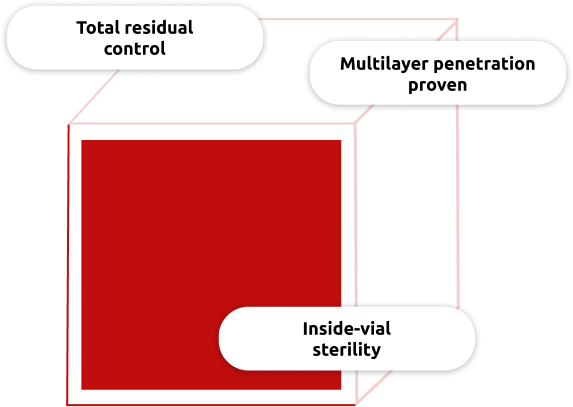
packaging barriers penetrated - PP corrugated outer box, Tyvek® sheet, Tyvek® lid, and two HDPE/Tyvek® header bags - to reach the vial interiors
- 89%
H₂O₂ consumption - compared with standard cycle: multivariate optimization reduced H₂O₂ consumption from 370 to 40g per cycle
WE DEVELOP THE STERILIZATION PROCESS AROUND THE COMPLETE PACKAGED LOAD
penetrating the complete multilayer packaging configuration, reaching the internal vial surfaces and providing documented sterility assurance: without making sterilization, aeration or final release a constraint on production capacity.
Our process combines a short cycle with low H₂O₂ consumption and no detectable residues.
The outcome is an industrial low-temperature process proven where sterility matters most: inside the vial.
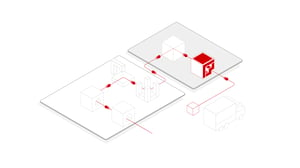

emerge sterile, dry and ready for immediate use.
Can the process be transferred from development to an industrial machine?
Yes. Vacuum level, injection pressure, H₂O₂ quantity, pulse sequence, temperature and exposure time are defined as controlled process parameters. The load configuration and critical conditions can then be reproduced on the production equipment and confirmed through qualification.
Can the same machine process different nested-vial configurations?
Potentially, but each configuration requires dedicated cycle development. Vial size, tray density, packaging materials, barrier permeability and box arrangement affect evacuation, vH₂O₂ distribution and aeration. Machine flexibility allows different recipes to be developed and controlled, but results cannot be transferred without verification.
How does the machine support rapid H₂O₂ residual removal?
Sterilization and aeration are managed within the same equipment. Repeated deep-vacuum and air-renewal phases remove residual vapour from the vials and multilayer packaging, supporting a shorter cycle and residual-controlled release.
Why must sterilization be developed around the complete packaged load?
The PP corrugated outer box, Tyvek® sheet and lid, double HDPE/Tyvek® header bags, tray arrangement and vial interiors create a complex penetration path. The process must therefore be developed and qualified on the final commercial configuration rather than on individual components.
Which machine capabilities enable vH₂O₂ to reach the vial interiors?
The sterilizer combines a high-performance deep-vacuum system with controlled vH₂O₂ injection. Vacuum removes trapped air from the packaging layers and vial interiors, while defined pressure pulses drive the sterilant through all five packaging barriers to the biological worst case.
How does the machine prevent condensation during the cycle?
The equipment controls chamber and load temperature throughout conditioning, injection and exposure. Maintaining the required temperature margin supports homogeneous vapour distribution and prevents condensation that could compromise penetration, material compatibility or residual removal.
Explore related knowledge
Discover how our process knowledge connects technologies, applications and processes.