
Solutions for CAR-T cell therapy
CAR-T therapies transform a patient’s own immune cells into a personalized treatment, but every individual batch must move through a complex, time-sensitive manufacturing journey.
Cell variability, manual operations, aseptic connections and fragmented equipment interfaces make execution difficult to standardize. At the same time, patient identity, material genealogy and process data must remain connected from leukapheresis to infusion.
Scaling this model therefore requires more than additional cleanrooms and operators. Manufacturers need to increase capacity while preserving sterility, repeatability, GMP control and the integrity of every patient-specific process.
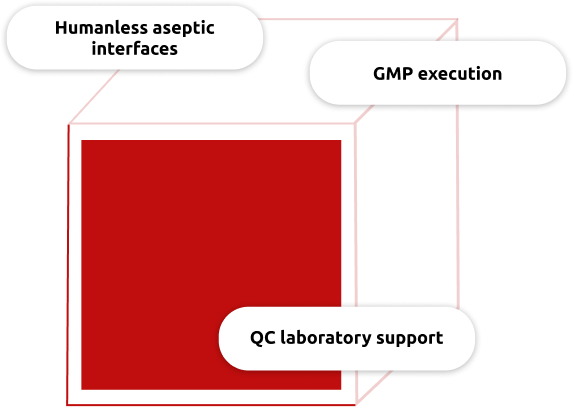
ROBOTICS CAN REDUCE MANUAL INTERVENTION
but robotics alone does not transform a cell-therapy workflow into pharmaceutical manufacturing.
Fedegari brings contamination-control, sterilization and GMP-validation expertise to the modular robotic architecture developed with Multiply Labs.
Robotic handling, instrument orchestration, controlled connections, aseptic transfers and digital process records are engineered as one manufacturing environment. Critical interactions with the product and supporting materials become controlled, repeatable and traceable.
Parallel operations and modular scale-out can then increase capacity without multiplying manual interfaces or redesigning the entire process, turning automation into a deployable GMP platform capable of supporting broader patient access.

emerge sterile, dry and ready for immediate use.
Why is robotics alone not sufficient for CAR-T manufacturing?
Robots can reproduce movements, but pharmaceutical manufacturing also requires contamination control, qualified equipment interfaces, controlled transfers, patient-specific traceability and documented process execution. These elements must be engineered together.
Can the platform support different CAR-T processes?
Yes. The modular architecture can integrate different GMP instruments and unit operations according to therapy and process requirements while preserving a common robotic and digital execution framework.
How does the solution reduce contamination risk?
Automated loading, unloading, connection and transfer reduce direct operator interaction with critical process interfaces. Controlled robotic execution and compatible sterilization functions support the preservation of aseptic conditions throughout the manufacturing sequence.
What role do washing and high-temperature sterilization play?
They support QC and process-development laboratories by treating reusable laboratory materials, glassware, culture media and compatible components. They are complementary laboratory technologies, not stages within the robotic cell-manufacturing cluster.
How does the approach support validation and traceability?
Process parameters, robotic interactions and material movements can be captured as electronic records. Repeatable execution and structured data support qualification, investigation and quality review across patient-specific batches.
How can manufacturing capacity be increased?
Multiple operations can run in parallel within each cluster. Additional clusters can then be deployed to increase capacity through scale-out without reproducing the full complexity of a conventional manual facility.
Explore related knowledge
Discover how our process knowledge connects technologies, applications and processes.
From breakthrough to manufacturing readiness: why ATMP industrialization becomes a patient safety issue
In advanced therapies, the scientific breakthrough comes first. But it is not enough
