
Configurable
washing
In pharmaceutical R&D and Quality Control, glassware and instruments support tests, formulations and microbiological activities whose reliability depends on what happens before the work begins.
Loads, geometries and residues change continuously. Yet an inadequate or inconsistent washing result can interfere with testing, compromise experimental work or require activities to be repeated.
Laboratories therefore need more than automated execution. They need a configurable washing process that adapts to changing applications while delivering repeatable, traceable results.
350–500L
effective chamber capacity
1- or 2-door
configurations for different laboratory layouts and workflows
2 months
delivery time from PO to FAT
GAMP 5
engineered and pre-validated process-control architecture
60+
years industrial pharmaceutical experience embedded in the Phase Group library
MOST LABORATORY WASHERS ALLOW USERS TO CONFIGURE CYCLES
We configure the washing process around the application.
We bring Phase Group architecture and process knowledge developed for industrial pharmaceutical applications into R&D and Quality Control. Steam action, water circulation, chemical dosing, rinsing and drying are coordinated around the load, while conductivity-based monitoring provides a measured condition for completing the process.
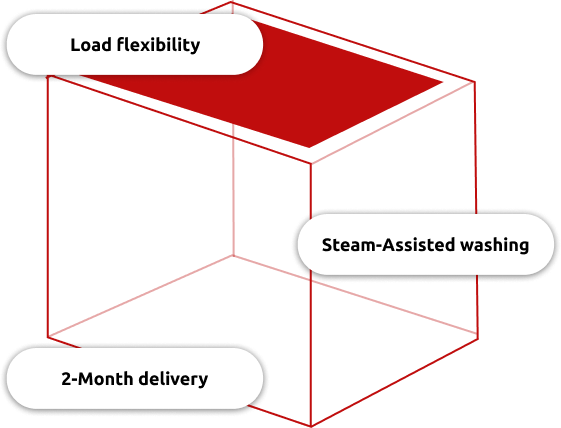
Modular load configurations and continuity with sterilization workflows protect laboratory flexibility without sacrificing process control.
The scale changes but the process logic remains.

STEAM-ASSISTED SOIL REMOVAL
Direct steam injection supports the removal of greasy and adherent residues while reducing water and detergent consumption.
RINSING BASED ON A MEASURED CONDITION
Conductivity monitoring controls drain-water quality and allows rinsing to continue until the defined set-point is reached.
DISINFECTION EFFECT TO REDUCE BIOBURDEN
Direct steam injection has a disinfection effect on the components with a relative reduction in bioburden.
DEDICATED PROCESS CONTROL FUNCTIONS
Our Process Control architecture provides dedicated functions specifically developed for terminal sterilization of liquid products:
- F₀ calculation (F(T,z))
- Lethality Factor (Lf) calculation
- Sterilization Time (ts) calculation
- Continuous recording of temperatures, pressures and phase transitions
Together, these functions provide objective evidence of sterilization performance, support validation activities and ensure complete process traceability throughout the entire cycle.
LABORATORY GLASSWARE
For bottles, flasks, beakers, measuring cylinders, pipettes and other glassware used in pharmaceutical R&D and Quality Control.
LABORATORY INSTRUMENTS AND COMPONENTS
For instruments and components that can be positioned on dedicated or customized racks and connected to the washing circuit where required.
WASHING AND STERILIZATION WORKFLOWS
Compatible loading systems create continuity between washing and sterilization within the laboratory workflow.
CHANGING LABORATORY LOADS
Modular rack configurations support different load geometries and washing requirements within the same laboratory environment.
What makes this different from a conventional laboratory washer?
The technology goes beyond configurable cycle parameters. Coordinated Phase Groups govern water circulation, steam action, chemical dosing, rinsing and drying, while modular racks configure the washing action around the load.
What is the role of conductivity monitoring?
The conductivity meter monitors drain-water quality and allows rinsing to continue until the defined set-point is reached. It provides a measured endpoint for the rinsing phase; it does not independently demonstrate the removal of every possible residue.
Can different types of glassware and instruments be processed?
Yes. Modular, customized racks with automatic hydraulic connection support different load geometries and direct the washing action inside glassware and around laboratory instruments.
Can washing and sterilization be integrated?
Yes. Compatible loading systems and coordinated process control create continuity between washing and high-temperature sterilization within the laboratory workflow.