Skip to content

Solutions for

blistered prefilled syringes

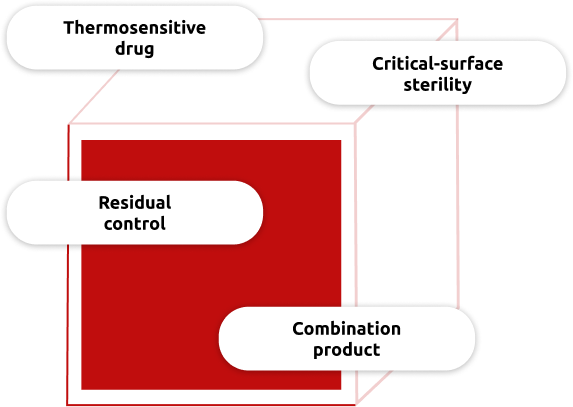
Drug-device combination products can bring together a thermosensitive drug, a complex delivery system and a protective package within a single sterilization challenge. For blistered prefilled syringes, the process must reach external surfaces, recessed areas and partially enclosed geometries without exposing the filled product to damaging temperatures. Sterilant penetration through the Tyvek® layer must therefore be demonstrated, together with microbial effectiveness inside the blister and around critical syringe components.

At the same time, manufacturers must protect drug stability, material compatibility and container-closure integrity, while ensuring that neither the product nor its packaging retains unacceptable sterilant residues.


Request more information
Key advantages of Fedegari low-temperature vH2O2 sterilization technology for drug-device combination products in Tyvek blister packaging

WE DEVELOP THE STERILIZATION PROCESS AROUND THE COMPLETE FILLED-SYRINGE AND BLISTER CONFIGURATION.

Proving microbial effectiveness while protecting the drug, device and packaging.

For this thermosensitive combination product, vaporized hydrogen peroxide is selected as the low-temperature sterilant. But sterilant selection is only the first step. The Tyvek® layer, the syringe lumen adjacent to the plunger stopper, the area beneath the backstop and the internal blister surfaces present distinct penetration challenges.

By combining vH₂O₂ exposure with controlled deep-vacuum pulses, we remove trapped air and promote sterilant penetration throughout the packaged system, achieving the required microbial reduction while preserving drug quality and combination-product integrity.

BLISTERED PREFILLED SYRINGES MANUFACTURING

solutions-for-hemodialysis-blood-tubing-artifical-valves-pack-suture-fedegari

FEDEGARI SOLUTIONS FOR BLISTERED PREFILLED SYRINGES

APPLICATION NUMBERS

SAL 10⁻⁶
sterility assurance level achieved for the documented blistered prefilled-syringe configuration.

<0.15 ppm*
residual H₂O₂ in the drug product, measured by UV-visible spectrometry

<0.05 ppm*
residual H₂O₂ in the blister, measured by UV-visible spectrometry

3 hours
total cycle time for the documented vH₂O₂ sterilization process

FREQUENTLY ASKED QUESTIONS

Why use H₂O₂ instead of steam for blistered prefilled syringes?

Steam may expose thermosensitive drugs, polymeric components and Tyvek® packaging to unsuitable temperatures and humidity. Vaporized H₂O₂ enables microbial reduction at lower temperatures while treating the external surfaces of the closed syringe within its blister.

Is the drug product itself sterilized by H₂O₂?

No. The objective is to sterilize the accessible device and blister surfaces while the drug remains protected by the syringe container-closure system. Nevertheless, potential H₂O₂ transfer into the drug must be analytically investigated during process development.

How does H₂O₂ enter a sealed blister?

The Tyvek® lid is porous to the sterilant. Deep vacuum removes air from the blister and recessed geometries, creating the conditions for vaporized H₂O₂ to penetrate the porous layer and contact the enclosed external surfaces.

Why is deep vacuum important?

Air trapped inside the blister, syringe lumen or beneath assembled components can obstruct sterilant distribution. Deep-vacuum and pressure-pulse sequences improve air removal and support H₂O₂ penetration into these difficult locations.

Can the same cycle be used for every prefilled syringe?

No. Syringe materials, drug formulation, stopper position, backstop geometry, blister volume, Tyvek® specification and load arrangement can all affect penetration, absorption and aeration. The cycle must be developed and validated around the actual commercial configuration.

Does the blister remain sterile after treatment?

The Tyvek® layer allows sterilant penetration during the cycle and subsequently functions as part of the microbial barrier. Seal integrity and packaging performance must be validated for the specific blister configuration and sterilization process.

How is product protection demonstrated?

Microbial effectiveness is assessed together with drug-product analysis, residual H₂O₂ testing, product-loss evaluation and container-closure integrity. This prevents achievement of SAL from being considered independently of combination-product quality.

At what point does sterilization occur?

In this application, H₂O₂ treatment occurs after the filled and assembled syringe has been sealed inside the Tyvek® blister and before final cartoning and serialization.

Knowledge Hub Regulatory

Aseptic Transfer: The fragile points of sterility Where process design determines whether sterility holds - or fails

Read this article

Immagine aseptic Transfer-2

Customer so closer is not a promise of proximity
It is a way of working.

A global network designed to keep Fedegari close to the customer, close to the process and close to the decisions that make sterile manufacturing safer, more reliable and more valuable over time.