Skip to content

Solutions for radiopharmaceuticals

Radiopharmaceutical production combines pharmaceutical contamination control with the radiological protection of operators and the surrounding environment.

The exact route varies with the radionuclide, formulation, product stability, container and intended diagnostic or therapeutic use. Some products are sterilizing-filtered and aseptically filled; others can be filled, closed and terminally sterilized. At the same time, reusable product-contact parts require controlled preparation, while radioactive wastewater cannot automatically enter the conventional drain.

Because usable activity decreases with time, component availability, product processing, quality control and downstream handling must remain coordinated, with limited manual intervention across classified and shielded areas.


Request more information
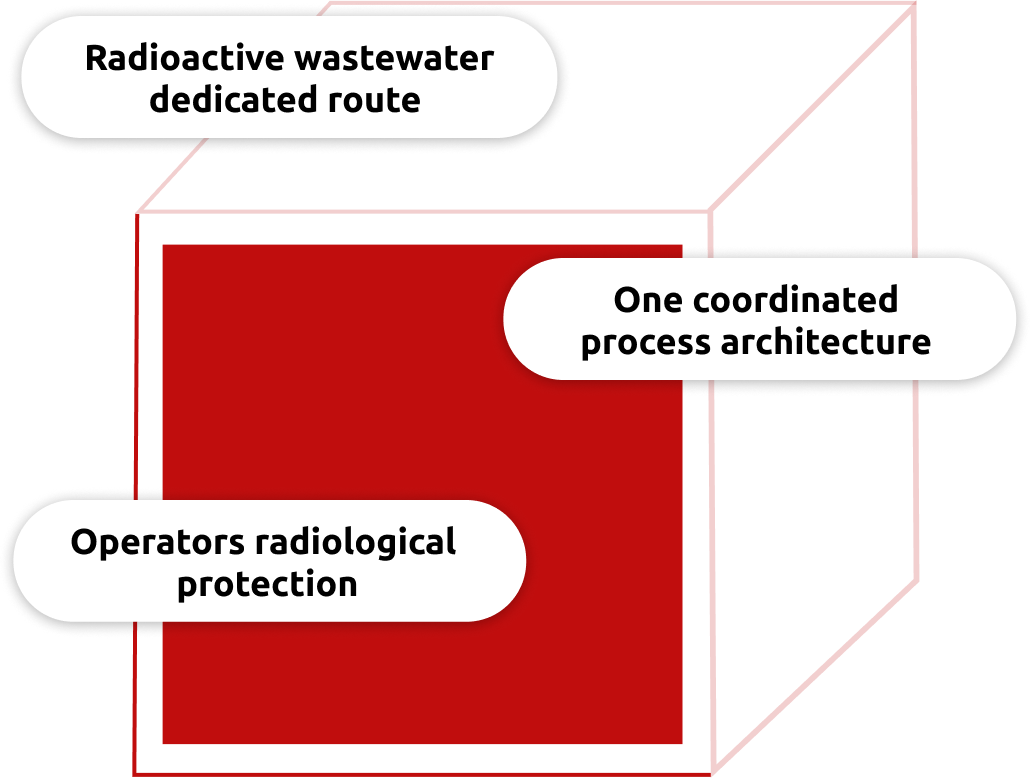
3D schematic illustration of a red cube featuring three callout badges: "Radioactive wastewater dedicated route" at the top left, "One coordinated process architecture" on the right, and "Operators radiological protection" at the bottom left.

CONTROLLING THE CRITICAL FLOWS AROUND RADIOPHARMACEUTICAL FILLING

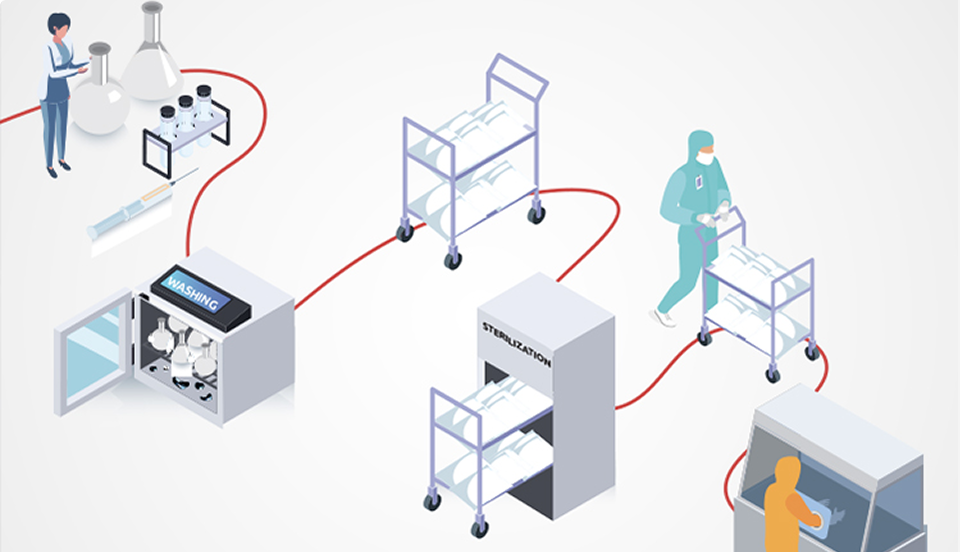
We configure the technologies around the actual product and production route. Reusable components can be washed and sterilized through separate pass-through systems or treated in a combined washing sterilization equipment. When the formulation and container-closure system permit terminal sterilization, filled and closed vials can be transferred automatically through the autoclave and onward to inspection, shielding and packaging. Radioactive wastewater generated during parts washing is routed to dedicated collection and decay storage, then verified before authorized discharge.

Automated or robotic handling connects these operations with hot cells, shielded isolators and classified areas while reducing direct intervention. The result is one coordinated process architecture for component readiness, product treatment and effluent control, defined through risk assessment around the radionuclide, half-life, formulation, container, activity, production rate and site procedures.

RADIOPHARMACEUTICALS MANUFACTURING

solutions-for-hemodialysis-blood-tubing-artifical-valves-pack-suture-fedegari

FEDEGARI SOLUTIONS FOR RADIOPHARMACEUTICALS

APPLICATION NUMBERS

UP TO 700
vials/8-hour run production output 

2
vials/minute line-productivity 

≥98%
uptime sytem-efficiency 

FREQUENTLY ASKED QUESTIONS

When is a combined washer-sterilizer preferable to separate equipment?

It is valuable when reducing transfers provides a meaningful benefit in operator exposure, classified-space use or component turnaround. A separate washer and pass-through autoclave may offer different capacity or scheduling flexibility. The choice depends on load, production frequency, interfaces, effluent strategy and required availability.

How are Fedegari systems integrated with hot cells and shielded areas?

Equipment and handling interfaces are configured around the required environmental classifications, containment pressure, shielding and transfer sequence. Automated and interlocked connections can reduce manual manipulation while preserving separation between process areas. Project responsibilities and interfaces must be defined with the hot-cell, filling and downstream-system suppliers.

Does Fedegari supply the complete radiopharmaceutical filling line?

Not necessarily. Fedegari’s scope can include parts washing, radioactive-effluent management, steam sterilization, terminal sterilization, automated handling and related process integration. Dispensing, hot cells, shielding and product-specific downstream equipment may belong to other suppliers and are connected through defined project interfaces.

Are radiopharmaceuticals always sterilizing-filtered and aseptically filled?

No. The route depends on the radionuclide, formulation, product stability, container-closure system and required shelf life. Some products use sterilizing filtration followed by aseptic filling; others can be filled and closed before terminal sterilization. The sterility strategy must therefore be defined for the actual product.

Why does a parts washer require a dedicated radioactive-effluent route?

Washing transfers radioactive residues from reusable components into wastewater. That liquid cannot automatically enter the conventional drain: it must be collected, retained according to isotope and activity, and verified against applicable site authorization and discharge criteria before controlled release.

When can terminal sterilization be integrated after filling?

It is applicable when the formulation and container-closure system tolerate the required thermal process without unacceptable effects on product quality, activity or package integrity. Cycle development must establish lethality, thermal exposure, container behaviour and handling requirements before terminal sterilization is incorporated into the downstream flow.

Knowledge Hub Regulatory

Aseptic Transfer: The fragile points of sterility Where process design determines whether sterility holds - or fails

Read this article

Immagine aseptic Transfer-2

Customer so closer is not a promise of proximity
It is a way of working.

A global network designed to keep Fedegari close to the customer, close to the process and close to the decisions that make sterile manufacturing safer, more reliable and more valuable over time.