
Solutions for high-viscosity products
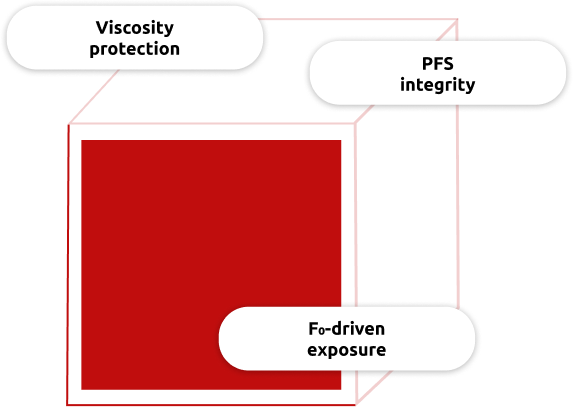
Hyaluronic acid pre-filled syringes combine a thermally sensitive formulation with a pressure-sensitive container-closure system. Product performance depends on the molecular weight and rheological behaviour of the formulation, while moist heat progressively reduces viscosity as exposure continues. At the same time, heating increases the internal pressure of the filled syringe through liquid expansion and vapour pressure, potentially causing plunger movement, leakage or loss of container integrity.
Achieving sterility without sacrificing the viscosity that defines product performance. Manufacturers therefore need to achieve the required lethality without applying unnecessary thermal stress, while protecting the syringe throughout heating, exposure and cooling. The challenge is not only sterility, but preserving the functional properties expected after processing.
NO PREDEFINED STERILIZATION CYCLE
We define the time-temperature profile around the actual response of the hyaluronic acid formulation and its pre-filled syringe.
Steam-air technology provides controlled counterpressure to limit plunger movement, while F₀-based cycle development balances the required microbial lethality against viscosity degradation.
We identify the sterilization profile that best protects the product, not simply the lowest processing temperature.
At our Technology Centers, we profile product response across sterilization strategies at 115°C, 121°C and 130°C, comparing different time-temperature combinations at equivalent lethality. This determines which profile best preserves viscosity and PFS integrity, rather than assuming that the lowest temperature is necessarily the gentlest.
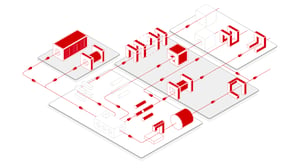
Reduced exposure, controlled connection to the barrier and readiness for closed or robotic reassembly
Integrated washing and sterilization of bulk closures, followed by closed transfer in a sterile tank.
Reusable heat-sensitive parts whose material, geometry, packaging and microbial-reduction requirements support a validated low-temperature route.
Steam-air technology combines F₀-driven exposure with controlled counterpressure, reducing unnecessary thermal stress while limiting plunger movement throughout heating, sterilization and cooling.
Compact layouts, fewer equipment interfaces, reduced classified-space demand or a single integrated route for compatible reusable loads.
Sealed RTU or pre-sterilized materials whose internal sterile state must be preserved while the outer packaging is treated before entry.
Controlled loading, unloading, movement, connection and delivery to reduce exposure and avoidable manual intervention.
Validated washing establishes the required cleanliness state for reusable product-contact, machine and format parts before downstream treatment.
Maintains treated bulk stoppers within a closed sterile environment during transfer from the washing and sterilization system to the automated manipulator.
Steam-air technology combines F₀-driven exposure with controlled counterpressure, reducing unnecessary thermal stress while limiting plunger movement throughout heating, sterilization and cooling.
Steam sterilization for compatible reusable parts packaged in bags or canisters before protected or closed transfer.

emerge sterile, dry and ready for immediate use.
Would a lower sterilization temperature better protect the product?
Not necessarily. A lower temperature requires a longer exposure to achieve the same F₀. In the documented comparison, the 115°C cycle caused the greatest viscosity reduction because of its prolonged duration.
Why is hyaluronic acid difficult to sterilize with moist heat?
Heat can reduce the molecular weight and viscosity of sodium hyaluronate. Because viscosity contributes directly to product behaviour, the cycle must achieve the required lethality while limiting accumulated thermal exposure.
What is a peak cycle?
A peak cycle uses a higher temperature for a much shorter period. For the tested formulation, this strategy achieved approximately the same F₀ while reducing viscosity loss compared with longer, lower-temperature cycles.
Is the same peak cycle suitable for every hyaluronic acid product?
No. The appropriate profile depends on formulation, molecular weight, concentration, fill volume, syringe geometry, plunger behaviour and product acceptance criteria. It must be developed and validated for the actual product-container system.
How is plunger movement controlled during sterilization?
Steam-air technology applies controlled air support pressure to counterbalance the pressure developing inside the filled syringe during heating, exposure and cooling.
How can product preservation be demonstrated?
Thermal measurements inside a representative PFS confirm the accumulated F₀, while rheological analysis compares the viscosity of sterilized samples with untreated product. Stability and container-closure assessments complete product-specific validation.
Explore related knowledge
Discover how our process knowledge connects technologies, applications and processes.