
Solutions for artificial valves
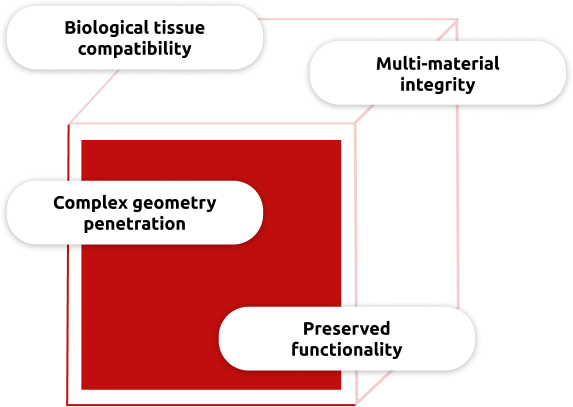
Artificial valves combine long-term implant performance with exceptional material and geometrical complexity. Biological tissues or collagen-based components may coexist with implantable textiles, polymeric films, metallic structures and surface treatments.
The sterilization process must reach external surfaces, internal cavities, layered structures and interfaces between dissimilar materials without altering mechanical response, dimensional stability, biocompatibility or haemodynamic function.
For these devices, sterility is therefore the minimum requirement, not the sole measure of success. The real manufacturing challenge is to establish a process that delivers the required microbial reduction while preserving every critical attribute on which the device’s clinical performance depends.
THE VALVE DEFINES THE STERILIZATION STRATEGY
We design the process around what the valve must preserve.
At our Technology Centers, representative challenge configurations reproduce difficult-to-reach pathways and interfaces among biological, textile, polymeric and metallic components. Deep-vacuum phases remove trapped air and create the conditions for vaporized hydrogen peroxide to penetrate complex or partially occluded assemblies.
The development programme then connects microbial-reduction performance, material compatibility, residual evaluation and functional CQA verification within one product-specific approach. The result is a documented, product-specific process that achieves the required sterility assurance objective while preserving intended valve functionality.
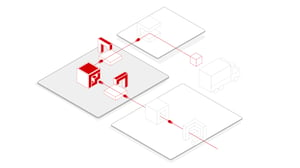
The vH₂O₂ process governs deep-vacuum phases, exposure and aeration to reach long, narrow lumens while controlling microbial reduction and residuals.
Automatic handling prepares repeatable load configurations and transfers packaged devices to the sterilizer, reducing manual intervention and product damage.
Automated unloading and downstream transfer preserve load traceability, increase sterilizer utilization and support continuous production flow.

emerge sterile, dry and ready for immediate use.
Why may low-temperature vH₂O₂ be considered for artificial heart valves?
Artificial heart valves can include heat-sensitive biological, polymeric and textile components. vH₂O₂ may provide a low-temperature alternative, but suitability must be established for the specific materials, preservation treatments, device configuration and packaging.
How is a representative Process Challenge Device defined?
The PCD should reproduce the product location, pathway or material interface presenting the greatest resistance to the sterilization process. Its configuration must be justified through product characterization and worst-case analysis rather than copied from a generic model.
Why is deep vacuum relevant for this application?
Complex assemblies can retain air within cavities, narrow regions, layered structures and partially occluded interfaces. Deep vacuum improves air removal and creates conditions that support sterilant access to locations that may otherwise be difficult to reach.
How is compatibility with biological tissue established?
Compatibility cannot be assumed for an entire tissue category. A product-specific programme compares relevant pre- and post-process attributes under defined cycle conditions and acceptance criteria, including the effects of repeated or worst-case exposure when required.
What must be verified beyond microbial reduction?
The verification strategy may include residuals, material appearance, dimensional stability, mechanical response, textile or tissue integrity, packaging integrity and other functional CQAs defined by the device manufacturer.
Explore related knowledge
Discover how our process knowledge connects technologies, applications and processes.