
Dry-heat
depyrogenation
Sterile manufacturing must control microorganisms, bacterial endotoxins and particles. Sterilization addresses viable contamination but does not necessarily eliminate endotoxins and pyrogens from glassware and product-contact components entering aseptic production.
Continuous depyrogenation tunnels are optimized for standardized, high-volume flows. Multi-product facilities must also manage changing batches, formats and non-standard components, creating the need for a flexible batch approach.
BATCH FLEXIBILITY SHOULD NOT COME AT THE EXPENSE OF VALIDATION CONFIDENCE
Every load configuration changes how heat moves through the chamber and reaches the materials being treated.
Fedegari engineers depyrogenation around the actual load, transforming this variability into a defined, repeatable and documented pharmaceutical process.
The required thermal exposure is demonstrated across the validated loading pattern, while ISO 5 conditions protect treated materials throughout treatment and controlled cooling.
The result is the flexibility to process different batches, formats and load geometries without compromising demonstrated endotoxin and pyrogens control or particulate protection.
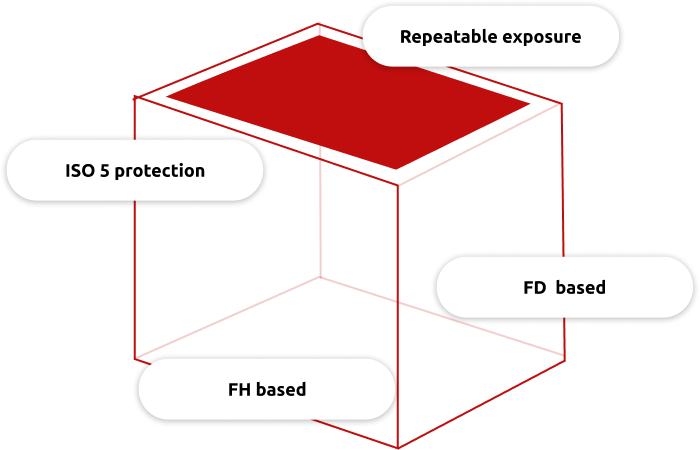

Fᴅ- DEPYROGENATION EQUIVALENT TIME AT REFERENCE TEMPERATURE 250°C
The equivalent exposure time used to quantify the endotoxin-inactivation effectiveness achieved by a dry-heat depyrogenation process.
LOAD-SPECIFIC HEAT DISTRIBUTION
High-recirculation airflow, adjustable deflectors and multi-point temperature measurement support repeatable thermal exposure across validated load configurations.
ISO 5 THROUGHOUT PROCESSING AND COOLING
Continuous HEPA-filtered airflow and controlled positive pressure protect treated materials from particulate contamination throughout processing and cooling.
FLEXIBLE BATCH PROCESSING
Different load types, quantities and configurations can be processed without depending on a continuous tunnel or dedicated production line.
DEDICATED PROCESS CONTROL FUNCTIONS
Thermal exposure as process evidence. We transform temperature data into documented evidence of cycle performance:
- Calculate FD for depyrogenation and FH for dry-heat sterilization
- Monitor the minimum and maximum temperatures measured by the probes
- Digitally record temperature trends and equivalent thermal exposure
BATCH DEPYROGENATION
Batch processing is particularly suited to changing formats, variable batch sizes, non-standard geometries and multiproduct manufacturing, including:
-
glassware batches
-
filling machine parts
-
stainless steel tanks
-
containers
DRY-HEAT STERILIZATION
The same technology performs dedicated dry-heat sterilization cycles for:
-
heat-stable items
-
water-free products unsuitable for steam sterilization
-
products requiring absolute dryness after processing
Typical applications include powders, dry excipients and non-aqueous liquids.
Is depyrogenation the same as sterilization?
No. Sterilization destroys or inactivates viable microorganisms. Depyrogenation destroys or removes pyrogens, primarily bacterial endotoxins. A component may therefore be sterile without meeting the required endotoxin limits.
Why is chamber temperature alone insufficient?
The chamber setpoint does not demonstrate the exposure received throughout the load. Geometry, quantity, position and airflow can influence heating behaviour. The required thermal exposure must therefore be demonstrated at the critical locations of each validated loading pattern.
How is depyrogenation efficacy evaluated?
Efficacy is determined by the combined effect of time and temperature and expressed as equivalent exposure FD . Thermal mapping and appropriate endotoxin challenges confirm that the required reduction has been achieved across the validated load.
How are ISO 5 conditions maintained during cooling?
The chamber continuously recirculates HEPA-filtered air and operates under controlled positive pressure. This protects treated materials from particle ingress during cooling and until cycle completion.
When is a batch oven preferable to a tunnel?
A batch oven is preferable when production involves changing formats, variable batches, multiproduct operation or components that cannot be handled through a continuous line. Tunnels remain more appropriate for standardized, high-volume container flows.
Can the same system perform dry-heat sterilization?
Yes. Dedicated cycles can sterilize heat-stable materials that are incompatible with steam, including powders, non-aqueous liquids and components requiring absolute dryness. Sterilization and depyrogenation are developed and validated as separate processes.
How does batch depyrogenation support aseptic transfer?
Double-ended configurations can be installed between areas of different classifications, allowing treated components to be transferred toward the aseptic environment through a controlled, unidirectional process. EU GMP Annex 1 explicitly recognizes double-ended depyrogenation ovens and tunnels for this purpose.