
Solutions for
surgical sutures
Packaged surgical sutures combine variables that respond differently to sterilization: absorbable or non-absorbable polymers, braided or monofilament structures, functional coatings and multilayer barrier systems.
Sterilization must therefore do more than achieve microbial inactivation. It must preserve the characteristics that determine how the finished device performs: mechanical strength, degradation behaviour, filament structure, coating functionality, package seals and barrier integrity. Each combination presents a distinct material-compatibility and process-development challenge.
2
filament architectures: braided and monofilament structures, with different materials, surface characteristics and functional requirements
2
absorption profiles: absorbable and non-absorbable sutures
16
specific combinations of sutures, coatings and packaging systems mapped for preliminary compatibility assessment
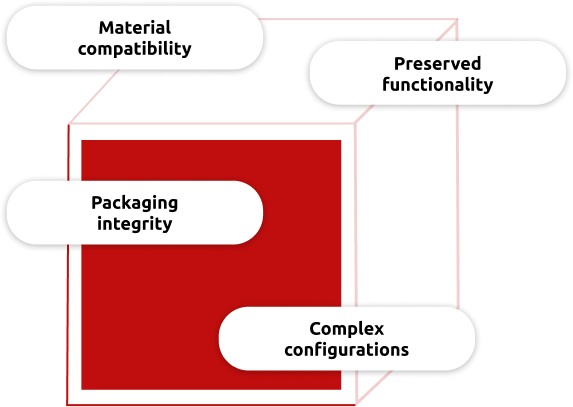
WE DEVELOP STERILIZATION AROUND THE COMPLETE PACKAGED DEVICE
from absorbable braided sutures with functional coatings to non-absorbable monofilaments protected by multilayer barrier systems.
The combinations to be treated may span Polyglactin 910, Polydioxanone, Polyester, Polyamide, Polypropylene and Polyethylene, together with aluminium pouches, paper–plastic laminates, Tyvek® sterile-barrier systems and more complex polymeric assemblies.
At our Technology Centers, the interaction between materials, filament architecture, coating, packaging and sterilant is assessed experimentally. Compatibility studies identify material response and critical product attributes, while microbiological testing, biological-indicator positioning and residual evaluation establish process effectiveness.
Vacuum, H₂O₂ injection, exposure and aeration parameters are then profiled around the most challenging locations and transferred to a defined industrial load configuration.
Different sutures. Different materials. One capability to develop the right sterilization process.
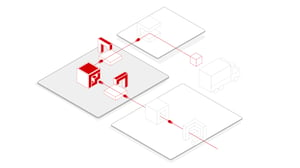
Automated unloading and downstream transfer preserve load traceability, increase sterilizer utilization and support continuous production flow.
Automatic handling prepares repeatable load configurations and transfers packaged devices to the sterilizer, reducing manual intervention and product damage.
The vH₂O₂ process governs deep-vacuum phases, exposure and aeration to reach long, narrow lumens while controlling microbial reduction and residuals.

emerge sterile, dry and ready for immediate use.
How does Fedegari select the most suitable IV bag sterilization process?
A risk-based assessment considers the bag, fill, headspace, seals, product sensitivity, required lethality, load, output, water impact and downstream operations. Representative bags can then be tested at Fedegari Tech Centers before the industrial process is finalized.
Why is superheated-water sterilization widely used for IV bags?
Superheated water provides rapid, homogeneous heating and cooling for high-capacity loads. Comparable exposure across load positions supports consistent lethality, while shorter transitions can limit unnecessary thermal stress on the product. The load exits wet, an acceptable trade-off when output and cost per bag are the main priorities.
When should steam-air sterilization be considered for IV bags?
Steam-air becomes attractive when lower water use, reduced wastewater and utility demand or dry unloading create greater value across the line. Continuous ventilation limits stratification and stagnant areas, while dry bags can move more directly to inspection, leak detection, labelling and packaging.
How are flexible IV bags protected during terminal sterilization?
As the liquid heats and cools, pressure inside the bag changes. Controlled chamber counterpressure balances these variations throughout heating, exposure and cooling, helping protect bag geometry, seals and ports from excessive swelling, deformation, leakage or rupture.
Why is automatic handling important in IV bag sterilization?
High batch capacity becomes line throughput only when loads are prepared, transferred and discharged consistently. Automated handling protects the bags and validated arrangement, while identification and tracking preserve the association between each batch, its load configuration, selected sterilization route and downstream handover.
Explore related knowledge
Discover how our process knowledge connects technologies, applications and processes.