
Solutions for radiopharma
Radiopharmaceutical manufacturing must protect the patient from contamination while protecting operators and the environment from the radioactive product. This dual requirement changes the production architecture: containment, shielding, airflow direction and limited operator access become primary design drivers.
The product must be sterile, its radioactivity must be contained.
The sterility route depends on the actual product: some radiopharmaceuticals are sterile-filtered and aseptically filled, while others can be filled, closed and terminally sterilized. The manufacturing environment must reflect the selected route and whether the sterile product is ever exposed.
STERILIZATION AS PART OF THE CONTAINMENT STRATEGY
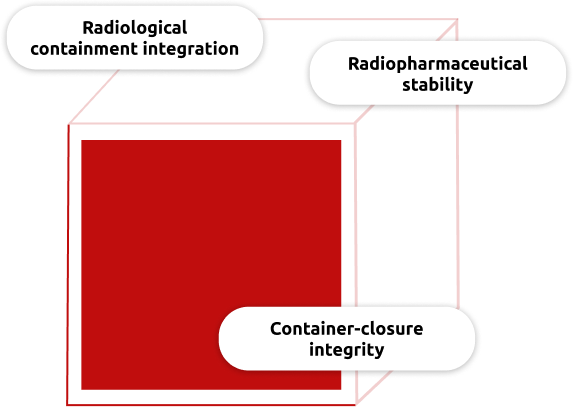
For radiopharmaceuticals, terminal sterilization must address 3 inseparable constraints: required lethality, product stability and radiological containment.
Together, these constraints define both the thermal cycle and the autoclave integration. Its configuration and interfaces are engineered around the hot-cell layout, shielding, pressure relationships, access restrictions and radioactive-contamination risks.
The result is more than a thermal cycle: a repeatable, validation-ready process integrated into the containment architecture, achieving sterility without introducing unnecessary operator exposure, avoidable time loss or a weak point between contained production and downstream operations.
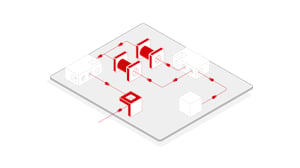
Filled and closed containers undergo a validated thermal cycle developed around required lethality, radiopharmaceutical stability, container integrity, radionuclide half-life and the available release window.
Laminar flow protecting WFI filling
Filled and closed containers undergo a validated thermal cycle developed around required lethality, radiopharmaceutical stability, container integrity, radionuclide half-life and the available release window.

emerge sterile, dry and ready for immediate use.
Does radioactivity remove the need for contamination control?
No. Radioactivity cannot be treated as a universal microbial-control mechanism. Radiopharmaceuticals intended for parenteral administration must still meet the applicable sterility requirements. The process must therefore protect the product from contamination while simultaneously protecting operators and the environment from radiation.
When can a radiopharmaceutical be terminally sterilized?
Terminal sterilization is applicable when the formulation and container-closure system tolerate the required thermal process without unacceptable changes in product quality, activity, radiochemical purity or package integrity. The available time between preparation, filling, sterilization, release and administration must also be considered.
Is a hot-cell the same as an isolator?
No. A hot-cell is a shielded workstation for manufacturing and handling radioactive materials and is not necessarily designed as an isolator. Its primary function is radiological protection. The contamination-control conditions required inside it depend on the process and whether sterile product or critical surfaces are exposed.
How is the autoclave integrated into the containment strategy?
The integration assessment considers hot-cell layout, shielding, pressure relationships, door interfaces and operator access. It should also address abnormal events such as container leakage or breakage, including potential chamber contamination, liquid collection, exhaust management and the conditions required for safe cleaning and maintenance.
How is the terminal sterilization process validated?
Validation includes defined minimum and maximum loads, temperature distribution, heat penetration, lethality and critical cycle parameters. The process must also be assessed against the actual formulation and container-closure system, including relevant acceptance criteria for product quality, activity, radiochemical purity and package integrity.
What environmental classification is required?
The required classification depends on the operation and must be supported by risk assessment. Grade C may be suitable for closed operations such as synthesis, purification and online sterile filtration. Aseptic activities involving exposed sterile product or critical surfaces must be performed under Grade A conditions.
Explore related knowledge
Discover how our process knowledge connects technologies, applications and processes.