
Solutions for
IV bags
IV bags are commonly manufactured in large quantities for the delivery of infusion solutions, electrolytes, nutrients and pharmaceutical formulations. Once filled and sealed, the complete product-container system must reach the required sterility assurance without compromising the formulation, the flexible bag, its seals or its ports.
For high-volume lines, the challenge extends to the economics and continuity of the complete production flow. Process time, bags per batch, loading and unloading, utility demand, water and wastewater, drying and downstream readiness all influence line output and cost per processed bag. The sterilization strategy must therefore protect product and container quality while preventing the post-filling process from becoming a production bottleneck.
CONFIGURING THE COMPLETE SYSTEM AROUND THE PRODUCTION PRIORITIES OF THE IV BAG LINE,
we combine superheated-water or steam-air terminal sterilization with automated or robotic handling.
Superheated water sterilization provides rapid heating and cooling when high heat-transfer performance and high-capacity processing are decisive. Steam-air reduces process-water demand, wastewater and operating costs while enabling dry unloading. Independent pressure and temperature control protects flexible bags, seals and ports throughout heating and cooling.
Automated load preparation, arrangement, loading and unloading preserve a repeatable load geometry, essential for consistent heat transfer, airflow and thermal exposure across the entire load. Load tracking and recipe management maintain the link between each configuration and its validated process. Faster transfers, reduced manual intervention and direct delivery to inspection or packaging improve sterilizer utilization and overall line performance.
.jpg?width=300&name=Infografica_Solutions%20for%20IV%20Bags%20_Sito_Fedegari_2026%20(1).jpg)
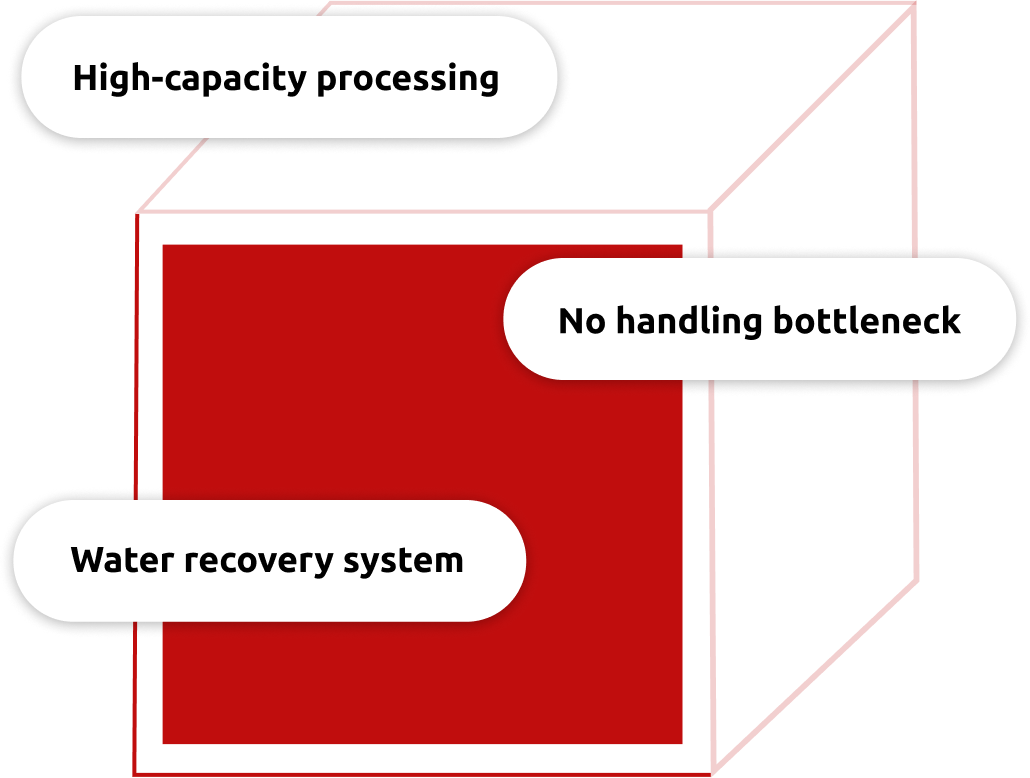
Rapid, homogeneous heating and cooling support more output from high-capacity IV bag loads while limiting unnecessary product exposure.
Automated loading, unloading and transfer turn cycle capacity into traceable line throughput by preserving bag arrangement and load identity without creating a handling bottleneck.
Continuous ventilation supports uniform exposure and independent pressure control protects flexible bags, while lower water impact and dry unloading prepare them for downstream operations.
Automated loading, unloading and transfer turn cycle capacity into traceable line throughput by preserving bag arrangement and load identity without creating a handling bottleneck.

emerge sterile, dry and ready for immediate use.
How does Fedegari select the most suitable IV bag sterilization process?
A risk-based assessment considers the bag, fill, headspace, seals, product sensitivity, required lethality, load, output, water impact and downstream operations. Representative bags can then be tested at Fedegari Tech Centers before the industrial process is finalized.
Why is superheated-water sterilization widely used for IV bags?
Superheated water provides rapid, homogeneous heating and cooling for high-capacity loads. Comparable exposure across load positions supports consistent lethality, while shorter transitions can limit unnecessary thermal stress on the product. The load exits wet, an acceptable trade-off when output and cost per bag are the main priorities.
When should steam-air sterilization be considered for IV bags?
Steam-air becomes attractive when lower water use, reduced wastewater and utility demand or dry unloading create greater value across the line. Continuous ventilation limits stratification and stagnant areas, while dry bags can move more directly to inspection, leak detection, labelling and packaging.
How are flexible IV bags protected during terminal sterilization?
As the liquid heats and cools, pressure inside the bag changes. Controlled chamber counterpressure balances these variations throughout heating, exposure and cooling, helping protect bag geometry, seals and ports from excessive swelling, deformation, leakage or rupture.
Why is automatic handling important in IV bag sterilization?
High batch capacity becomes line throughput only when loads are prepared, transferred and discharged consistently. Automated handling protects the bags and validated arrangement, while identification and tracking preserve the association between each batch, its load configuration, selected sterilization route and downstream handover.
Explore related knowledge
Discover how our process knowledge connects technologies, applications and processes.