
Solutions for hemodialysis blood tubing set
Hemodialysis blood tubing sets form the extracorporeal connection between the patient and the dialysis system. During treatment, the patient’s entire circulating blood volume passes through a fluid path formed by flexible tubing, chambers, connectors and branches. Any failure in sterility, material compatibility, mechanical integrity or residual control can therefore affect clinical safety.
EtO has historically served these complex devices because of its penetration capability. Transitioning away from it, is not a simple change of sterilant: manufacturers must demonstrate reach across long, narrow and not always fully vented internal paths, microbiological efficacy, product compatibility and acceptable residuals - while avoiding the prolonged degassing, inventory and release constraints associated with EtO.
295–385cm
length of the tubing paths addressed in the documented configuration
SAL 10⁻⁶
sterility assurance level supported by microbiological evidence
≈8 hours
total cycle duration, including optimized aeration
≈5mm
internal tubing diameter in the documented configuration
<1ppm
residual H₂O₂ measured after the complete cycle
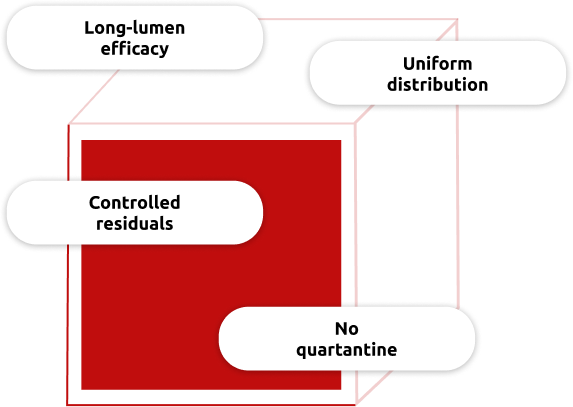
FOR HEMODIALYSIS BLOOD TUBING SETS, STERILANT SELECTION IS ONLY THE STARTING POINT
For heat-sensitive medical devices, we select H₂O₂ when compatibility, packaging and microbial-reduction requirements support low-temperature sterilization.
Long, narrow lumens, non-vented sections and difficult-to-reach internal surfaces require a specifically developed sterilization process. We govern vH₂O₂ exposure together with controlled deep-vacuum phases to remove trapped air and enable the sterilant to reach the entire fluid path.
Thermostatic control prevents unwanted condensation, while high-efficiency injection maintains the required vapour concentration. Final aeration supports residual removal, achieving H₂O₂ levels below 1ppm. Together with demonstrated microbial-reduction performance, this substantiates the transition from EtO without extended degassing quarantine.
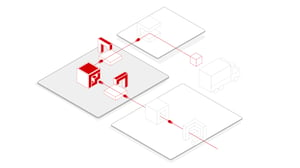
The vH₂O₂ process governs deep-vacuum phases, exposure and aeration to reach long, narrow lumens while controlling microbial reduction and residuals.
Automatic handling prepares repeatable load configurations and transfers packaged devices to the sterilizer, reducing manual intervention and product damage.
Automated unloading and downstream transfer preserve load traceability, increase sterilizer utilization and support continuous production flow.

emerge sterile, dry and ready for immediate use.
Why are hemodialysis blood tubing sets difficult to sterilize?
The critical surfaces extend through tubing up to 295–385cm long with an internal diameter of approximately 5mm. Narrow, branched and partially vented sections resist air removal, sterilant penetration and subsequent aeration, making the internal fluid path the true worst-case geometry.
What is the role of deep vacuum in the vH₂O₂ cycle?
Deep-vacuum pulses remove trapped air and establish controlled pressure gradients through the tubing. Fedegari integrates those pulses with conditioning, vH₂O₂ injection and exposure so the sterilant reaches the difficult internal surfaces rather than treating only the exterior of the device.
How does Fedegari define and substantiate the process?
Development begins with device materials, lumen geometry, packaging, load density, bioburden, target microorganism, required 6-log or 12-log reduction, residual limits and product functionality. Distribution mapping, biological indicators, residual analysis and material checks then connect the selected cycle parameters to sterilant reach, microbiological efficacy and acceptable product performance.
What operational advantages support the transition from EtO?
The documented vH₂O₂ process requires no extended EtO degassing quarantine, shortening the path to release and reducing work in process and storage occupation. Customers can also source H₂O₂ from qualified external vendors rather than a proprietary consumable channel, improving procurement flexibility, supply-chain resilience and lifecycle OPEX control.
Can vH₂O₂ be treated as a direct replacement for EtO?
No generic one-to-one substitution should be assumed. Device materials, geometry, packaging, load and acceptance criteria must be assessed together. Fedegari establishes the applicable process window through distribution, microbiological and residual evidence for the specific configuration.
How are hydrogen peroxide residuals controlled?
Aeration is developed as an integral cycle phase, not as a separate afterthought. In the documented tubing-set configuration, the optimized sequence reduced residual H₂O₂ below 1ppm after the complete approximately eight-hour process.
Explore related knowledge
Discover how our process knowledge connects technologies, applications and processes.
Beyond EtO: sterilizing complex medical devices in Industrial applications
The next phase of EtO replacement will not be won by technology selection alone
