
Sterility
test isolation
A positive sterility test can place an entire batch on hold. But when contamination originates from the testing environment, the result triggers investigations, retesting and release delays without revealing a manufacturing failure.
At the opposite extreme, residual H₂O₂ can inhibit microbial recovery and conceal contamination.
EU GMP Annex 1, FDA cGMP, WHO GMP and the associated pharmacopoeias therefore require sterility testing to be performed under controlled aseptic conditions, because the test environment must neither create contamination nor suppress its detection.
1ppm
typical monitored residual threshold reached during aeration before testing begins
6-log
surface bioburden reduction through a validated H₂O₂ bio-decontamination cycle
±15ppm
H₂O₂ concentration stability maintained through direct feedback control
ISO 5/Grade A
controlled working environment for aseptic execution of the sterility test
WE BRING CONTAMINATION-CONTROL PROCESS DISCIPLINE TO STERILITY TESTING ISOLATION
combining an ISO 5/EU GMP Grade A environment with an integrated, feedback-controlled H₂O₂ bio-decontamination system.
The difference is direct process control.
Instead of relying on the quantity of peroxide injected or on estimated chamber conditions, the system measures the H₂O₂ concentration achieved in the vapor phase and governs it through a feedback loop.
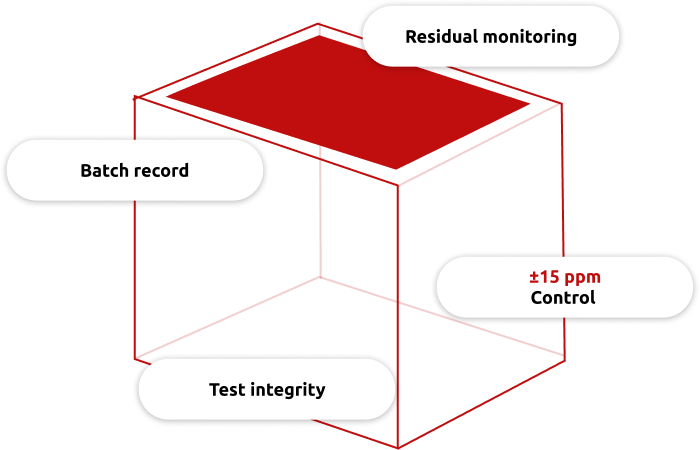
The result is stable H₂O₂ concentration within ±15ppm - even when load patterns change. Measured bio-decontamination. Protected test integrity.

TEST SENSITIVITY PROTECTED BEFORE TESTING BEGINS
Low-range monitoring controls residual H₂O₂ during aeration, preventing the bio-decontamination process from interfering with microbial recovery.
VALIDATION CONFIDENCE IN EVERY CYCLE
Actual H₂O₂ concentration, exposure conditions and peroxide consumption are recorded in the batch report, not simply confirmation that the programmed cycle was executed.
LOWER OPERATING COSTS WITHOUT CONSUMABLE LOCK-IN
Customers can select the supplier and concentration of the aqueous H₂O₂ solution, eliminating proprietary peroxide dependency and reducing long-term operating costs.
DEDICATED PROCESS CONTROL FUNCTIONS
Before every cycle, automated chamber and glove leak testing verifies the isolation boundary. Double inflatable door gaskets maintain chamber integrity throughout all the phases:
- Dehumidification
- Conditioning
- Bio-decontamination
- Aeration
- Sterility Testing
BATCH-RELEASE TESTING FOR STERILE DRUG PRODUCTS
For injectable liquids, freeze-dried drugs, sterile antibiotic powders and other sterile preparations, isolation prevents contamination introduced during testing from being attributed to the manufactured product.
HIGH-THROUGHPUT QUALITY-CONTROL LABORATORIES
Modular chambers, configurable glove ports, custom racks, a dedicated transfer pass-box and an internal trolley support continuous material flow across multiple products and testing procedures.
INCOMING STERILE MATERIALS AND COMPONENTS
The controlled environment protects incoming raw materials, components and samples from contamination during handling and analysis.
Which regulatory and pharmacopoeial requirements does the technology address?
The system is designed for sterility testing under EU GMP Annex 1, FDA cGMP and WHO GMP requirements and supports test execution according to USP <71> and Ph. Eur. 2.6.1 within an ISO 5/EU GMP Grade A environment.
Why perform sterility testing inside an isolator?
The isolator separates the test from operators and the surrounding environment, reducing the risk that contamination introduced during testing generates a false-positive result, an unnecessary investigation or a delayed batch release.
What differentiates Fedegari’s H₂O₂ process?
Fedegari directly measures and controls H₂O₂ concentration in the vapor phase. The feedback loop maintains concentration within ±15ppm instead of relying only on the programmed quantity of peroxide injected.
How does the system protect against false-negative results?
Residual H₂O₂ can inhibit microbial recovery. A dedicated low-range sensor monitors the aeration phase until the defined residual threshold is reached before testing begins.
Does the system require proprietary H₂O₂ consumables?
No. Customers can select the supplier and concentration of the aqueous hydrogen peroxide solution according to their operating requirements.
DISCOVER CONNECTED SOLUTIONS
Explore related knowledge
Discover how our process knowledge connects technologies, applications and processes.