
Applying our knowledge of Dalton’s law, we interpret how the partial pressures of steam and air contribute to chamber pressure and translate the changing internal conditions of the blister into a phase-specific counterpressure strategy. Pressure levels, ramp rates and transitions are developed to keep the differential across the peel seal within its acceptable range throughout heating, exposure and cooling.
Blister
A sealed blister changes throughout thermal sterilization. As temperature rises, the liquid expands, part of it may vaporize and the gas in the headspace increases in pressure. The resulting internal pressure acts directly on the blister cavity and its peel seal.
The same interaction continues during cooling, when the product, the headspace gas and the sterilization environment may respond at different rates. If chamber pressure does not follow the changing internal conditions closely enough, the differential can deform the blister, stress the seal or compromise package integrity.
This becomes especially critical for thin packaging and easy-peel seals, where improved usability leaves a narrower operating margin. Sterility must therefore be achieved within a pressure-temperature profile developed around the behaviour of the complete filled blister.
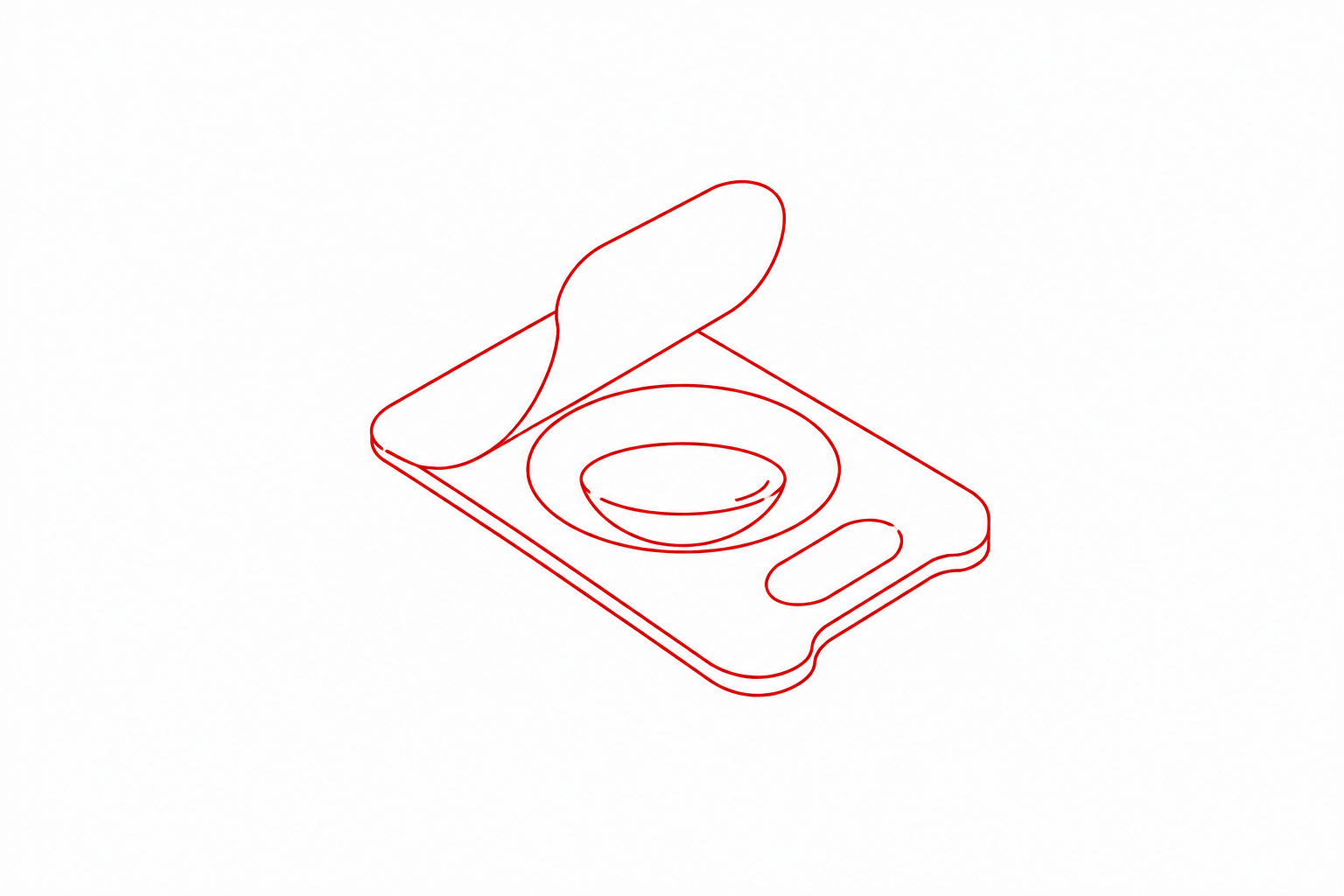
This capability has been applied to a 1mm flat pack with an easy-peel seal requiring only 5–7N opening force.
Despite this narrow mechanical tolerance, the validated process has supported the production of billions of packaged lenses, with zero seal failures across two decades of operation.
This long-term performance demonstrates our ability to achieve the required biological effectiveness while keeping the process within the demonstrated mechanical limits of the package.
20 years. Billions of packaged lenses. Zero seal failures.
OUR APPROACH
We begin with the actual blister configuration: fill volume, headspace, geometry, materials, seal strength and allowable deformation. These characteristics determine how internal pressure changes as the product heats, expands, generates vapour and subsequently cools.
Applying our knowledge based on Dalton’s law, we interpret how the partial pressures of steam and air contribute to chamber pressure and translate the changing internal conditions of the blister into a phase-specific counterpressure strategy. Pressure levels, ramp rates and transitions are developed to keep the differential across the peel seal within its acceptable range throughout heating, exposure and cooling.
The operating window is then challenged on the complete filled blister, verifying the required biological effectiveness together with seal integrity and package deformation. The resulting evidence defines both the cycle profile and the process limits needed to reproduce it consistently over time.
This capability allows us to develop thermal sterilization processes around the demonstrated tolerance of each blister configuration - even when packaging thickness and peel strength leave very little margin for error.
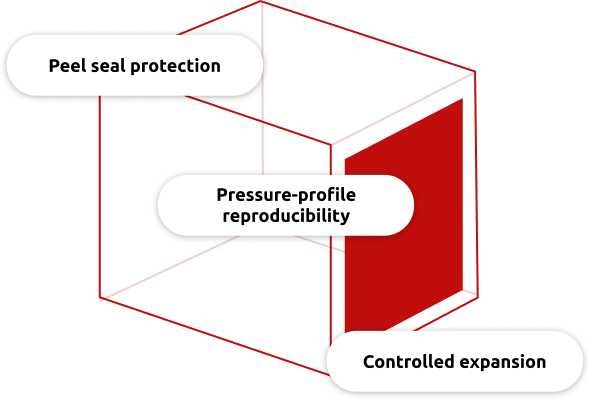
We convert the blister’s physical behaviour into a reproducible pressure-control strategy.
The operating window is then challenged on the complete filled blister, verifying the required biological effectiveness together with seal integrity and package deformation.
The resulting evidence defines both the cycle profile and the process limits needed to reproduce it consistently over time.
This capability allows us to develop thermal sterilization processes around the demonstrated tolerance of each blister configuration - even when packaging thickness and peel strength leave very little margin for error.

PRESSURE CONTROL
In saturated steam sterilization, pressure governs steam conditions. Controlling pressure supports temperature uniformity and repeatable process behavior. ±0.5°C UNIFORMITY
Temperature standard deviation is a key indicator of process behavior. The tighter the deviation, the greater the stability and repeatability across the entire load. DRY-LOADS
Critical components emerge sterile, dry and ready for immediate use.
CANISTER PROVEN
We support advanced canister-based transfer strategies while preserving filter integrity, drying performance and sterile transfer conditions.Can the same pressure profile be used for different blister formats?
Not automatically. Fill volume, headspace, package geometry, material properties and seal strength all influence internal pressure and mechanical behaviour. Each relevant configuration must be evaluated to establish its acceptable operating window.
Why must counterpressure also be controlled during cooling?
The product, headspace gas and sterilization environment do not cool or contract at the same rate. Reducing chamber pressure too quickly can therefore create a damaging differential even after the sterilization exposure has ended.
Does counterpressure prevent the blister from expanding?
Not completely. Some expansion or movement may be physically unavoidable. Counterpressure governs the differential acting across the package, keeping expansion and seal stress within the demonstrated acceptable range.
Why can a sealed blister open during thermal sterilization?
Heating causes the liquid, vapour and headspace gas inside the blister to expand and increase in pressure. If internal pressure rises faster than chamber pressure, the resulting differential acts directly on the peel seal and may cause deformation, leakage or opening.
Why is an easy-peel seal particularly difficult to protect?
An easy-peel seal is intentionally designed to open with limited force. This improves usability but reduces the pressure differential the package can tolerate during sterilization, requiring a narrower and more accurately controlled process window.
Is maintaining constant counterpressure sufficient?
No. Internal blister pressure changes continuously as the product heats, reaches the exposure temperature and cools. Counterpressure must therefore follow the package dynamically rather than remain fixed throughout the cycle.
DISCOVER CONNECTED SOLUTIONS
Explore related knowledge
Discover how our process knowledge connects technologies, applications and processes.