
Biohazard
decontamination
In laboratories handling biologically hazardous materials, microbial inactivation is only part of the challenge.
Before treatment is complete, contaminated air, aerosols, liquids and condensate can create potential exposure pathways for operators, the facility and the surrounding environment. The process must therefore do more than deliver the required thermal treatment. It must contain every potentially contaminated output and prevent its release until the cycle has been successfully completed.
Nothing potentially hazardous should leave the process before it has been safely treated.
WE COMBINE HIGH-TEMPERATURE MICROBIAL INACTIVATION WITH CONTROLLED CONTAINMENT OF POTENTIALLY CONTAMINATED PROCESS OUTPUTS
The complete process is configured around the biological risk.
Air, aerosols, liquids and condensate remain contained, while absolute filtration and dedicated exhaust treatment prevent untreated material from leaving the system before successful cycle completion.
Different door, bioseal and BSL3 configurations extend this control to the interface between laboratory areas.
Inactivation inside. Containment throughout.

TREATMENT CONFIGURED AROUND THE RISK
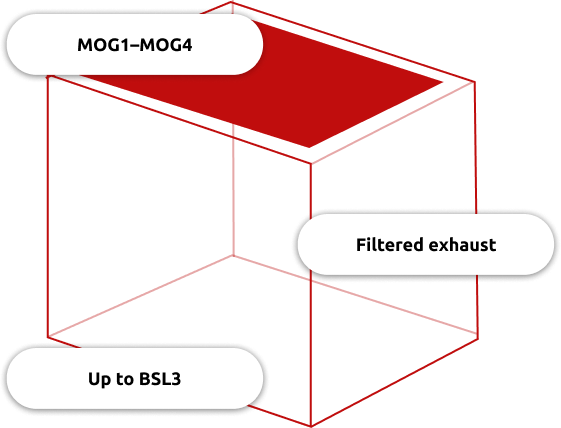
Dedicated process configurations address contaminated materials and biological waste across different MOG classifications.
CONTROLLED AIR AND EXHAUST PATHWAYS
Absolute filtration and dedicated exhaust-line treatment prevent untreated contaminants from leaving the system.
PROTECTION ACROSS LABORATORY AREAS
Single- or double-door layouts, different bioseal configurations and BSL3 solutions maintain containment at the interface between laboratory environments.
DEDICATED PROCESS CONTROL FUNCTIONS
Thermal inactivation, absolute exhaust filtration, filter and exhaust-line sterilization, and release logic are coordinated within one closed process sequence.
Potentially contaminated air, liquids and condensate remain within the controlled boundary until successful cycle completion, preventing untreated process outputs from being released.
HIGH-RISK BIOLOGICAL WASTE
For MOG3 and MOG4 biological waste requiring containment of potentially contaminated air and condensate until successful treatment.
CONTAMINATED LABORATORY MATERIALS
For laboratory materials classified as MOG1 or MOG2 requiring high-temperature treatment before removal or reuse.
PASS-THROUGH DECONTAMINATION
For double-door installations where contaminated materials must be treated before transfer from a contained area to a different laboratory environment.
HIGH-CONTAINMENT LABORATORIES
For BSL3 environments requiring dedicated bioseal configurations and controlled interfaces between laboratory areas.
Why is thermal inactivation alone not sufficient for biohazardous materials?
Before successful cycle completion, air, aerosols, liquids and condensate may still be contaminated. The technology therefore combines thermal inactivation with containment and treatment of potential release pathways.
How are high-risk biological loads managed?
Dedicated MOG3/MOG4 configurations prevent potentially contaminated air and condensate from being released before the cycle has been successfully completed.
Can the technology support separation between laboratory areas?
Yes. Single- and double-door configurations, different bioseal arrangements and dedicated BSL3 solutions support controlled installation at the interface between laboratory environments.
How are air and exhaust pathways controlled?
Potentially contaminated air passes through absolute filtration. Dedicated phases sterilize the filter and treat the exhaust lines before release.