
GMP robotic
ATMP factory
ATMP manufacturing still relies on highly trained operators to connect systems, load instruments, transfer materials and coordinate operations across fragmented process equipment. Every connection, transfer and movement creates another opportunity for contamination, variability, delay or manufacturing failure.
Yet when every batch may represent one patient, manufacturing failure is not simply an operational deviation. Published industry data indicate that approximately 4–7% of patients are unable to receive their CAR-T treatment because of manufacturing issues.
GREATER PRODUCTION CAPACITY, SHORTER AND MORE PREDICTABLE MANUFACTURING TIMELINES FOR BROADER PATIENT ACCESS.
Automating individual unit operations is not enough. Reliability depends on controlling the interfaces between them: material entry, instrument loading, connections, fluid transfers, movement between process steps and data capture.
The robotic technology powered by MultiplyLabs integrates biomanufacturing instruments, robotic handling, contamination control and digital orchestration within one controlled manufacturing flow.
At Fedegari we industrialize this robotic innovation for pharmaceutical manufacturing, transforming a flexible robotic concept into a scalable and repeatable GMP production system engineered for qualification, validation and parallel execution.

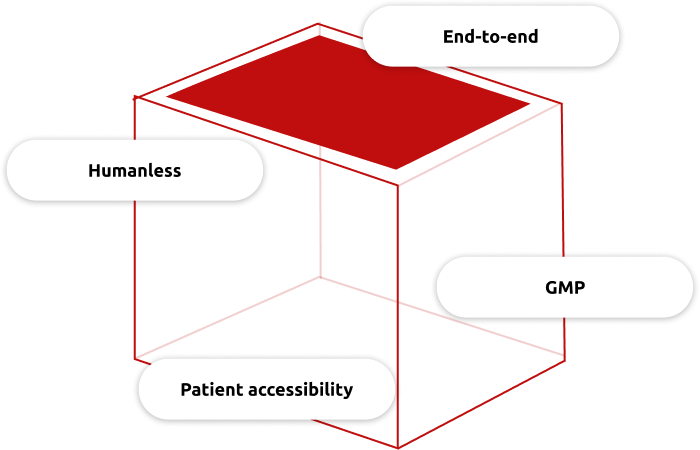
END-TO-END PROCESS ORCHESTRATION
Instruments, robots, material movements and data operate as one system. Every action is coordinated and automatically captured in the electronic batch record.
ESTABLISHED PROCESSES + LOW VALIDATION BURDEN
Automation integrates established instruments and consumables without forcing the process into a proprietary platform.
MORE THERAPIES IN SHORTER TIME TO PATIENTS
Parallel operations increase capacity without proportionally adding operators or cleanroom space. Shorter, more predictable manufacturing timelines expand patient access.
Robots can automate tasks but GMP manufacturing requires more: controlled aseptic conditions, qualified equipment integration, data integrity and documented evidence for validation.
We apply decades of pharmaceutical process, contamination-control and industrial engineering experience to transform innovative robotic platforms into scalable systems engineered for qualification, validation and GMP operation.
Engineering the complete transition from automation concept to industrial pharmaceutical manufacturing: we make robotic innovation manufacturable.
The modular manufacturing architecture can be configured around three main advanced-therapy manufacturing models.
PATIENT-SPECIFIC IMMUNE CELL THERAPIES
Autologous manufacturing processes in which each batch is produced for an individual patient, including CAR-T, TCR-T and tumor-infiltrating lymphocyte therapies.
DONOR-DERIVED AND ALLOGENEIC THERAPIES
Scalable manufacturing processes for donor-derived or off-the-shelf immune-cell products, including allogeneic CAR-T, NK, CAR-NK and dendritic-cell therapies.
STEM CELL AND REGENERATIVE THERAPIES
Manufacturing processes based on hematopoietic, mesenchymal and pluripotent stem cells for regenerative medicine and tissue-engineering applications.
The combination of instruments, consumables, robotic interfaces and unit operations is configured around the specific therapy and manufacturing process.
Does automation require replacing existing process instruments?
No. The modular architecture is designed to integrate established biomanufacturing instruments, including equipment from different suppliers.
Robotic interfaces allow existing instruments and process consumables to be automated without transferring the entire workflow into a proprietary all-in-one platform.
Can the system be configured for different ATMP processes?
Yes. Instruments, modules, robotic operations and process sequences are configured around the specific therapy.
The same manufacturing architecture can therefore support different autologous, allogeneic and regenerative-medicine workflows without imposing one fixed process.
Does the robotic manufacturing flow eliminate operators?
It removes operators from repetitive and contamination-critical aseptic interfaces within the automated process.
Human expertise remains essential for process supervision, quality oversight, deviation management and decision-making. Robots protect execution repeatability while people focus on the activities where their knowledge adds the greatest value.
How does Fedegari make a robotic platform suitable for GMP manufacturing?
Fedegari brings pharmaceutical process engineering, contamination control and industrial production capabilities to the robotic architecture.
This includes controlled-environment design, aseptic integration, equipment coordination, data integrity, validation support, repeatable system manufacturing and lifecycle management.
How are process data and electronic records managed?
The digital orchestrator records process parameters, material genealogy, robotic interactions and operator actions throughout execution.
Electronic records are generated automatically and made available to the quality system, eliminating manual transcription and supporting data integrity and 21 CFR Part 11 requirements.
How can robotic automation reduce vein-to-vein time?
Automation reduces manual handovers, waiting time and coordination delays between manufacturing steps. Parallel operation also allows robotic and process resources to be used more efficiently.
The technology therefore shortens and stabilizes the manufacturing contribution to overall vein-to-vein time.
Scritta legata al
mondo della case
studies e molto
altro
Lorem ipsum dolor sit amet consectetur. Varius nulla nulla risus ullamcorper urna ut nulla tristique.
Discover more

