
Glass vials
The rapid growth of biologics, nanoparticle-based medicines and Advanced Therapy Medicinal Products (ATMPs) is redefining the relationship between pharmaceutical formulations and primary packaging.
Interactions between proteins such as insulin, nanoparticles and container surfaces are well-recognised phenomena that can influence product stability, efficacy and patient safety. As these therapies become increasingly sensitive, material compatibility can no longer be considered an intrinsic property of the container alone.
Before a drug product is ever filled, glass vials undergo washing, depyrogenation and steam sterilization. These manufacturing processes progressively transform the material surface, influencing how it will ultimately interact with the formulation.
GLASS VIAL BEHAVIOUR IS A PROCESS OUTCOME.
Material behaviour of a glass vail is not an intrinsic property: it is progressively defined by the manufacturing process.
During washing, depyrogenation and steam sterilization, glass surfaces undergo thermal, mechanical and chemical stresses that modify their physical and chemical characteristics. These transformations influence how the packaging will interact with increasingly sensitive pharmaceutical formulations.
Equivalent sterilization does not mean equivalent material behaviour
Sterilization cycles delivering the same microbiological lethality (F₀) can generate different surface characteristics depending on the process conditions. Sterility may be equivalent, while material behaviour is not.
Material evolution is cumulative throughout sterile manufacturing
Surface properties are not determined by a single process step. They are progressively shaped by the combined effects of washing, depyrogenation and steam sterilization.
Material behaviour influences formulation behaviour
Changes in surface characteristics influence interactions with proteins and lipid nanoparticles, affecting adsorption phenomena and the behaviour of highly sensitive pharmaceutical formulations.
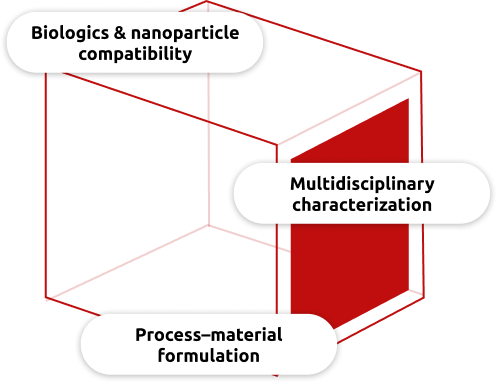
WHY FEDEGARI KNOWS
Our understanding of material behaviour begins with governing the manufacturing sequence that prepares primary packaging for aseptic production. Throughout washing, depyrogenation and steam sterilization, materials are exposed to thermal, mechanical and chemical stresses that progressively define the surface the drug product will ultimately encounter.
We connect process behaviour, material evolution and formulation performance to understand how manufacturing history transforms material behaviour and, in turn, influences product performance.
This multidisciplinary research approach follows the complete cause-and-effect relationship.
SURFACE EVOLUTION
Each process condition was correlated with measurable changes in surface SEM morphology, AFT topography, Nanomechanical properties and surface zeta potential, allowing material evolution to be objectively characterised.
FORMULATION BEHAVIOUR
Surface evolution was correlated with the behaviour of representative pharmaceutical formulations to understand how material changes influence product performance.
Interaction studies using model proteins and Solid Lipid Nanoparticles (SLN) revealed measurable adsorption phenomena and correlations between surface properties, including roughness and isoelectric point, and formulation behaviour.
This research represents the foundation of our understanding of how sterile manufacturing defines material behaviour.
emerge sterile, dry and ready for immediate use.
Why are biologics and nanoparticle formulations more sensitive to surface interactions?
Proteins and nanoparticle-based formulations are particularly susceptible to adsorption and aggregation phenomena. Even small changes in surface properties can influence formulation behaviour and long-term stability.
Why do washing and depyrogenation matter?
Material surfaces evolve throughout the entire preparation sequence. Washing, depyrogenation and steam sterilization each contribute to defining the final state of the packaging before filling.
How can material behaviour be characterised?
A multidisciplinary approach combining surface morphology, topography, nanomechanics and surface charge allows material evolution to be correlated with pharmaceutical formulation behaviour under representative manufacturing conditions.
Why isn't equivalent F₀ enough to guarantee equivalent material behaviour?
Equivalent F₀ demonstrates equivalent microbiological lethality, but different temperature profiles and process conditions can produce different surface characteristics. Sterility may therefore be equivalent while material behaviour is not.
Why is this knowledge becoming increasingly important?
As pharmaceutical products become more complex, understanding how sterile manufacturing shapes material behaviour is becoming an essential part of designing predictable, repeatable and robust aseptic manufacturing processes.
VALIDATED WASHING
Pharmaceutical parts and components can carry viable microorganisms, particles and chemical residues, including endotoxins. As manufacturers move from operator-dependent manual washing to automated processes, the objective is not simply repeatable execution, but a demonstrated cleaning outcome across all three contamination classes.
DRY-HEAT DEPYROGENATION
Sterile manufacturing must control microorganisms, bacterial endotoxins and particles. Sterilization addresses viable contamination but does not necessarily eliminate endotoxins and pyrogens from glassware and product-contact components entering aseptic production.
Continuous depyrogenation tunnels are optimized for standardized, high-volume flows. Multi-product facilities must also manage changing batches, formats and non-standard components, creating the need for a flexible batch approach.
INSULIN PROCESSING
Insulin production increasingly relies on high-throughput syringes and cartridge filling lines, with cartridges serving reusable and disposable delivery pens. At these output levels, filling capacity alone does not determine production performance.
Closures and reusable filling-line parts must be washed, sterilized, handled and delivered to the filling area at the required pace and under controlled aseptic conditions. If these upstream activities are managed as separate, disconnected operations, they can become a bottleneck while increasing equipment, transfers, manual handling and operating costs.
VACCINES
Vaccine manufacturing places exceptional demands on fill-finish operations, where product sterility depends on the controlled preparation and transfer of every component entering the aseptic filling area.
Sterile vials, stoppers and product-contact machine parts must be available in step with the filling line and introduced without contamination or particle exposure. Multiple preparation systems, intermediate containers and manual transfers increase process complexity, footprint and critical interfaces. Dependence on ready-to-use components can also limit sourcing and campaign flexibility.
ALBUMIN PASTEURIZATION
Albumin is a heat-sensitive biological product. Once prepared, purified, formulated and stabilized, it is sterile-filtered and aseptically filled into final glass vials or bottles. Because it is not subjected to conventional terminal sterilization at 121°C, the filled and sealed containers undergo validated pasteurization at 60°C for at least 10 hours to support viral inactivation while preserving protein stability and product quality.
Albumin pasteurization is traditionally performed in water-bath systems. Although effective for heat transfer, this established approach requires very large quantities of process water, increasing utility consumption, wastewater generation and operating costs across a long and production-critical treatment
RADIOPHARMA
Radiopharmaceutical production combines pharmaceutical contamination control with the radiological protection of operators and the surrounding environment. The exact route varies with the radionuclide, formulation, product stability, container and intended diagnostic or therapeutic use. Some products are sterilizing-filtered and aseptically filled; others can be filled, closed and terminally sterilized. At the same time, reusable product-contact parts require controlled preparation, while radioactive wastewater cannot automatically enter the conventional drain.
HIGH-VISCOSITY PRODUCTS
Hyaluronic acid pre-filled syringes combine a thermally sensitive formulation with a pressure-sensitive container-closure system. Product performance depends on the molecular weight and rheological behaviour of the formulation, while moist heat progressively reduces viscosity as exposure continues. At the same time, heating increases the internal pressure of the filled syringe through liquid expansion and vapour pressure, potentially causing plunger movement, leakage or loss of container integrity.
STERILE POWDER MANUFACTURING
Sterile powder manufacturing presents one of the most demanding combinations of aseptic processing and high-containment production. Reusable containers, machine parts and thermosensitive materials must each follow dedicated preparation pathways before entering the filling environment, while uninterrupted production campaigns require a sufficient number of sterile containers to be available before filling can even begin. The challenge therefore extends well beyond aseptic filling itself: manufacturers must coordinate washing, depyrogenation, sterilization, material bio-decontamination, protected transfers and containment into a single validated manufacturing workflow that preserves both product sterility and operator safety.
CAR-T CELL THERAPY
CAR-T therapies transform a patient’s own immune cells into a personalized treatment, but every individual batch must move through a complex, time-sensitive manufacturing journey.
Cell variability, manual operations, aseptic connections and fragmented equipment interfaces make execution difficult to standardize. At the same time, patient identity, material genealogy and process data must remain connected from leukapheresis to infusion.
HIGH-POTENT ASEPTIC MANUFACTURING
High-potent sterile manufacturing is one of the fastest-growing pharmaceutical sectors, driven by oncology biologics, antibody-drug conjugates (ADCs), peptides and other highly active compounds. While aseptic filling remains essential, manufacturers must simultaneously protect product sterility, operators and the surrounding environment. As occupational exposure limits decrease to the ng/m³ range, every reusable machine component leaving the filling isolator becomes a potential contamination source.

THE CUBE HAS MORE THAN THREE FACES
Explore how Fedegari has approached sterile process challenges across different industries, applications and manufacturing environments.
WHITE PAPER AND RESEARCH
Technical depth, documented and made accessible. A growing collection of papers and research contributions developed from real application experience across industries, processes and manufacturing environment.
