
Combined
sterilization and decontamination
Modern pharmaceutical facilities must support an increasing variety of materials, production scenarios and transfer requirements. This demands access to both sterilization and surface decontamination: two distinct processes serving different treatment needs.
Traditionally, providing both capabilities requires an autoclave and a separate H₂O₂ pass box, increasing classified footprint, equipment interfaces and the number of systems to qualify, integrate and maintain.
This is especially critical in multi-product and brownfield facilities, where production requirements continue to evolve but classified space and existing infrastructure cannot expand at the same pace: more treatment flexibility cannot mean more infrastructure anymore.
COMBINED STERILIZATION AND DECONTAMINATION INTEGRATES STEAM STERILIZATION AND H₂O₂ SURFACE DECONTAMINATION WITHIN THE SAME CHAMBER WHILE PRESERVING A DEDICATED CONTROL STRATEGY FOR EACH PROCESS.
The chamber is shared. each process retains its own control strategy.
Steam sterilization is governed through pressure-based control, multi-point temperature monitoring and configurable Phase Groups. H₂O₂ surface decontamination is controlled through direct concentration measurement and feedback, with defined exposure and aeration conditions.
Digitally controlled cooling flows and valves establish the chamber conditions required for the selected treatment. Non-proprietary H₂O₂ solutions also preserve customer freedom in process development and sourcing.
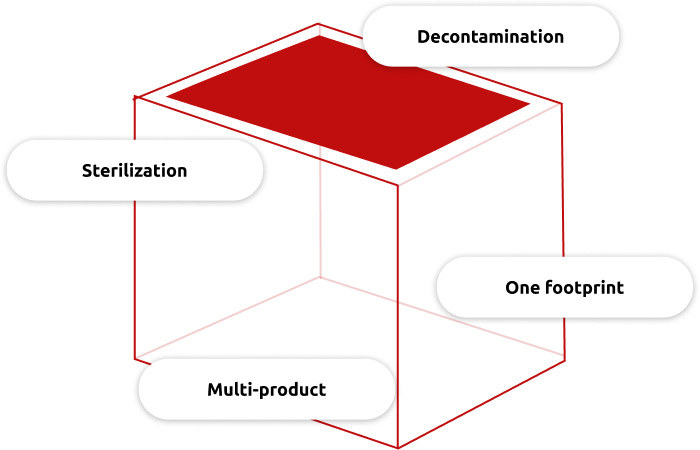
REDUCE QUALIFICATION AND LIFECYCLE BURDEN
One combined platform reduces the number of systems, process interfaces and maintenance strategies required to provide both treatment capabilities.
MAINTAIN FREEDOM IN H₂O₂ SOURCING
No proprietary hydrogen peroxide solution is required. Customers select the H₂O₂ supplier according to their validated process.
RELIABLE OUTCOMES ACROSS BOTH TREATMENTS
Pressure-based control, multi-point RTD monitoring and modular Phase Groups govern steam cycles. Direct H₂O₂ concentration measurement and feedback control loop govern surface-decontamination cycles.
DEDICATED PROCESS CONTROL FUNCTIONS
Pressure-based control, multi-point RTD monitoring and modular Phase Groups govern steam penetration, temperature uniformity and drying.
Digital control of cooling flows and valves prepares the chamber for the H₂O₂ cycle. Dual-sensor feedback controls H₂O₂ concentration, while settable exposure and aeration phases govern surface decontamination and residual removal.
MULTI-PRODUCT FACILITIES
Support different load families and evolving production scenarios, making both steam sterilization and H₂O₂ surface decontamination available without multiplying dedicated equipment.
BROWNFIELD AND SPACE-CONSTRAINED PROJECTS
Add H₂O₂ surface decontamination alongside steam sterilization when classified space or existing infrastructure does not allow the installation of a separate pass box.
TRANSFER INTO STERILITY-TEST ISOLATORS
Provide the appropriate treatment for each material entering a sterility-test isolator—from steam sterilization to H₂O₂ surface decontamination—through one integrated access point.
Why choose combined sterilization and decontamination instead of separate equipment?
Combined Sterilization and Decontamination provides both capabilities without requiring a dedicated H₂O₂ pass-box, reducing equipment count, classified footprint and lifecycle burden.
Which materials can undergo H₂O₂ surface decontamination?
Compatible heat-sensitive materials, presterilized components and external packaging surfaces can be treated according to the validated cycle.
Is a proprietary H₂O₂ solution required?
No. Customers can select any supplier for the aqueous hydrogen peroxide solution.
Does Combined Sterilization and Decontamination Retain Standard Autoclave Capabilities?
Yes. Combined Sterilization and Decontamination performs the saturated-steam cycles of a standard autoclave while adding H₂O₂ surface decontamination.
Can both treatments be performed in the ame chamber?
Yes. The appropriate cycle is selected according to the treatment requirements of each load.
Is H₂O₂ used for sterilization or surface decontamination?
In Combined Sterilization and Decontamination applications, H₂O₂ is used for surface decontamination. Saturated steam remains the sterilization technology.
ASEPTIC TRANSFER
Aseptic manufacturing depends on preserving the required state of every material until its point of use. Yet reusable parts, pre-sterilized components, bulk closures, tools and auxiliary materials enter the process from different conditions, through different routes and with different vulnerabilities.
Treatment alone does not secure the flow: unloading, transport, storage, manipulation and connection create critical interfaces where control can be lost. As manufacturing architectures become more closed, integrated and automated, aseptic transfer becomes a system-level responsibility.
RTU CARTRIDGES
RTU manufacturing carries more value - and more responsibility.
Ready-to-use cartridge manufacturers are taking on a critical role in biopharmaceutical supply chains. By supplying cartridges already washed, depyrogenated, siliconized, assembled, packaged and sterile, they enable pharma companies to outsource container preparation and the associated validation burden.
INSULIN PROCESSING
Insulin production increasingly relies on high-throughput syringes and cartridge filling lines, with cartridges serving reusable and disposable delivery pens. At these output levels, filling capacity alone does not determine production performance.
Closures and reusable filling-line parts must be washed, sterilized, handled and delivered to the filling area at the required pace and under controlled aseptic conditions. If these upstream activities are managed as separate, disconnected operations, they can become a bottleneck while increasing equipment, transfers, manual handling and operating costs.
VACCINES
Vaccine manufacturing places exceptional demands on fill-finish operations, where product sterility depends on the controlled preparation and transfer of every component entering the aseptic filling area.
Sterile vials, stoppers and product-contact machine parts must be available in step with the filling line and introduced without contamination or particle exposure. Multiple preparation systems, intermediate containers and manual transfers increase process complexity, footprint and critical interfaces. Dependence on ready-to-use components can also limit sourcing and campaign flexibility.
ALBUMIN PASTEURIZATION
Albumin is a heat-sensitive biological product. Once prepared, purified, formulated and stabilized, it is sterile-filtered and aseptically filled into final glass vials or bottles. Because it is not subjected to conventional terminal sterilization at 121°C, the filled and sealed containers undergo validated pasteurization at 60°C for at least 10 hours to support viral inactivation while preserving protein stability and product quality.
Albumin pasteurization is traditionally performed in water-bath systems. Although effective for heat transfer, this established approach requires very large quantities of process water, increasing utility consumption, wastewater generation and operating costs across a long and production-critical treatment
RADIOPHARMA
Radiopharmaceutical production combines pharmaceutical contamination control with the radiological protection of operators and the surrounding environment. The exact route varies with the radionuclide, formulation, product stability, container and intended diagnostic or therapeutic use. Some products are sterilizing-filtered and aseptically filled; others can be filled, closed and terminally sterilized. At the same time, reusable product-contact parts require controlled preparation, while radioactive wastewater cannot automatically enter the conventional drain.
STERILE POWDER MANUFACTURING
Sterile powder manufacturing presents one of the most demanding combinations of aseptic processing and high-containment production. Reusable containers, machine parts and thermosensitive materials must each follow dedicated preparation pathways before entering the filling environment, while uninterrupted production campaigns require a sufficient number of sterile containers to be available before filling can even begin. The challenge therefore extends well beyond aseptic filling itself: manufacturers must coordinate washing, depyrogenation, sterilization, material bio-decontamination, protected transfers and containment into a single validated manufacturing workflow that preserves both product sterility and operator safety.
HIGH-POTENT ASEPTIC MANUFACTURING
High-potent sterile manufacturing is one of the fastest-growing pharmaceutical sectors, driven by oncology biologics, antibody-drug conjugates (ADCs), peptides and other highly active compounds. While aseptic filling remains essential, manufacturers must simultaneously protect product sterility, operators and the surrounding environment. As occupational exposure limits decrease to the ng/m³ range, every reusable machine component leaving the filling isolator becomes a potential contamination source.
RTU VIALS
Ready-to-fill vial manufacturers supply pharmaceutical companies with primary containers that are already washed, depyrogenated, packaged and sterile, transferring container preparation and part of its qualification burden upstream. Growing demand for injectable biologics is increasing production volumes while making conventional sterilization routes more difficult to sustain. Steam may exceed the thermal limits of some packaging materials, while EtO introduces toxic-residue concerns and extended degassing times.
COMBINATION PRODUCTS
Drug-device combination products can bring together a thermosensitive drug, a complex delivery system and a protective package within a single sterilization challenge. For blistered prefilled syringes, the process must reach external surfaces, recessed areas and partially enclosed geometries without exposing the filled product to damaging temperatures. Sterilant penetration through the Tyvek® layer must therefore be demonstrated, together with microbial effectiveness inside the blister and around critical syringe components.
HIGH-VISCOSITY PRODUCTS
Hyaluronic acid pre-filled syringes combine a thermally sensitive formulation with a pressure-sensitive container-closure system. Product performance depends on the molecular weight and rheological behaviour of the formulation, while moist heat progressively reduces viscosity as exposure continues. At the same time, heating increases the internal pressure of the filled syringe through liquid expansion and vapour pressure, potentially causing plunger movement, leakage or loss of container integrity.
Scritta legata al
mondo della case
studies e molto
altro
Lorem ipsum dolor sit amet consectetur. Varius nulla nulla risus ullamcorper urna ut nulla tristique.
Discover more

