
RTS
stoppers
Ready-to-Sterilize (RTS) stoppers are expected to enter aseptic manufacturing immediately after sterilization through Rapid Transfer Port (RTP) systems. This requires every sterilization cycle to deliver stoppers in the same microbiological and physical condition, ensuring repeatable process performance from batch to batch.
For this reason, sterilization defines more than microbiological safety. It also determines the physical condition in which the stopper enters the filling process, influencing production readiness from the very beginning.
Residual humidity, final load temperature and cycle duration are therefore not simply process parameters. Together with sterility, they define whether an RTS stopper is ready to become part of a predictable and repeatable aseptic manufacturing process.
THE AUTOCLAVE DEFINES THE PHYSICAL CONDITION OF THE STOPPER
Physical condition is not defined by a single process parameter. It is the measurable combination of microbiological, moisture and thermal conditions in which an RTS stopper leaves sterilization and enters aseptic manufacturing.
Achieving this condition requires sterility, drying and cooling to be governed as one continuous process rather than independent process phases.
We don't simply sterilize RTS stoppers. We engineer the physical condition required for the next manufacturing process.
Microbiological condition
Validated steam sterilization establishes the sterility required for aseptic manufacturing.
Moisture condition
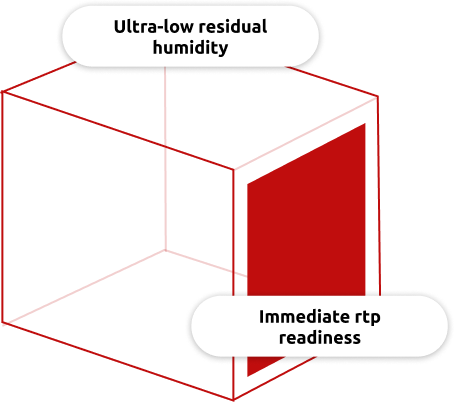
Residual humidity defines the amount of moisture remaining within the stopper after sterilization and drying. For moisture-sensitive products, this becomes part of the process conditions entering filling.
Thermal condition
Final load temperature determines when sterilized stoppers can be transferred through RTP systems and introduced into production.
Manufacturing consistency
Only when sterility, drying and cooling are governed together does every batch leave the autoclave in the same repeatable physical condition.
ENGINEERING THE PHYSICAL CONDITION
Physical condition is not verified after sterilization.
It is engineered during the process and demonstrated through measurable industrial results.
IMMEDIATE RTP READINESS
Through the integration of sterilization, drying and cooling, we consistently deliver RTS stoppers at a final load temperature of ≤50 °C, enabling immediate RTP transfer without additional cooling or waiting time before filling.
INDUSTRIAL CYCLE PERFORMANCE
By optimizing the complete sterilization process, we achieve full process readiness in approximately 5–6 hours, combining industrial productivity with the repeatability required for aseptic manufacturing.

PRESSURE CONTROL
In saturated steam sterilization, pressure governs steam conditions. Controlling pressure supports temperature uniformity and repeatable process behavior. ±0.5°C UNIFORMITY
Temperature standard deviation is a key indicator of process behavior. The tighter the deviation, the greater the stability and repeatability across the entire load. DRY-LOADS
Critical components emerge sterile, dry and ready for immediate use.
CANISTER PROVEN
We support advanced canister-based transfer strategies while preserving filter integrity, drying performance and sterile transfer conditions.How is RTS stopper sterilization different from bulk stopper processing?
RTS stopper sterilization begins with components already prepared for sterilization and focuses on delivering validated sterility together with the physical condition required for aseptic manufacturing. Bulk stopper processing additionally integrates washing, particle removal and endotoxin removal before sterilization.
Furthermore, RTS caps are packaged in Tyvek® bags and therefore the sterilization process acts on a static and more challenging product compared to the bulk process, where the caps are processed without disposable packaging and moved continuously.
Why is a final load temperature below 50 °C important?
Maintaining a controlled unloading temperature allows RTS stoppers to be transferred immediately through RTP systems without additional cooling, reducing waiting time before filling.
Why is a 5–6 hour cycle significant?
A complete cycle includes sterilization, drying and cooling. Optimizing all three phases reduces manufacturing time while maintaining the physical condition required for repeatable aseptic processing. The reduction in cycle duration directly implies an increase in productivity in the department, ensuring the possibility of carrying out other sterilization cycles (for example a machine parts cycle) during production shifts.
Why isn't sterility alone sufficient for RTS stoppers?
Sterility confirms microbiological safety. Residual humidity, final load temperature and cycle repeatability determine the physical condition in which the stopper enters aseptic manufacturing and its readiness for predictable production.
Why is residual humidity important?
Residual humidity is part of the physical condition created during sterilization. Controlling residual moisture supports repeatable manufacturing conditions and helps reduce variability, particularly for moisture-sensitive pharmaceutical products.
How is residual humidity measured?
Fedegari uses the GRAV gravimetric method, measuring stopper weight loss after controlled heating to constant weight to determine residual humidity objectively.
DISCOVER CONNECTED SOLUTIONS
Explore related knowledge
Discover how our process knowledge connects technologies, applications and processes.
Regulatory - Process safety
Aseptic Transfer: the fragile points of sterility.
Where process design determines whether sterility holds - or fails
.jpg?width=300&name=fedegari_group_aseptic-transfer-the-fragile-points-of-sterility%20(1).jpg)