
Automated
handling
In high-capacity terminal sterilization lines, production continuity depends on much more than sterilizer performance. Products must be accumulated, configured, loaded, processed, unloaded and transferred downstream without interrupting the production flow.
When handling and sterilization are engineered separately, every interface can generate delays, product damage, inconsistent load configurations and unclear responsibilities.
The performance of the line depends on governing product flow and sterilization as one coordinated process.
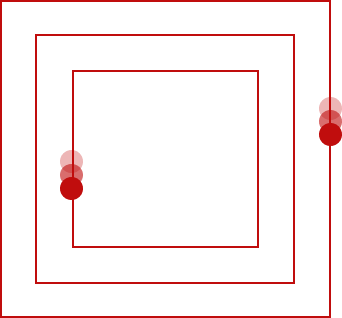
MOST HANDLING SYSTEMS MOVE PRODUCTS BETWEEN MACHINES.
We integrate handling directly with the sterilization process.
Product accumulation, load formation, transfer, cycle execution, unloading and downstream movement are engineered within one coordinated control architecture. Once the predefined criteria are met, the sterilization cycle is automatically initiated.
One process.
One control architecture.
One accountable partner.
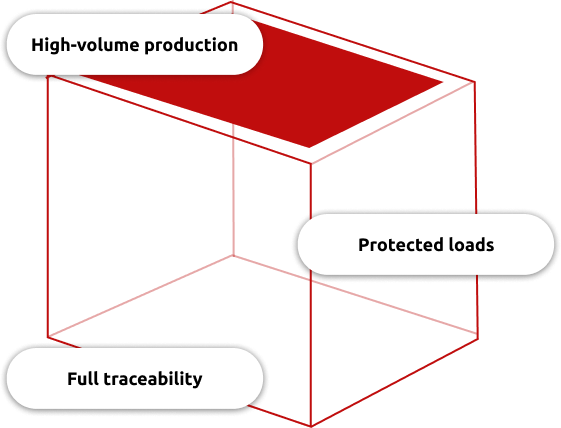
ONE COORDINATED PRODUCTION FLOW
Accumulation, loading, cycle execution, unloading and downstream transfer operate as one synchronized flow, supporting continuous high-capacity production.
REPEATABLE LOADS + PROTECTED PRODUCTS
By reproducing the required load configuration and positioning every product consistently, automated handling supports repeatable product exposure and sterilization performance across every cycle, while protecting containers and devices during transfer.
ONE PARTNER ACROSS EVERY INTERFACE
We take full responsibility for mechanical integration, automation, safety logic, process synchronization, testing and qualification support across the complete system.
DEDICATED PROCESS CONTROL FUNCTIONS
The coordinated control architecture governs product accumulation, load formation, transfer permissions, sterilizer readiness, automatic cycle initiation and unloading as one synchronized process.
Predefined logic authorizes each operation only when the required conditions are met, maintaining the association between load identity and cycle execution throughout the production flow.
IV BAGS
Flexible containers require controlled accumulation, positioning and transfer to prevent deformation and reproduce the required load pattern. Automated handling protects the bags while supporting consistent product exposure across every cycle.
VIALS AND BOTTLES
High-speed handling must maintain line continuity while minimizing glass-to-glass contact, breakage and positioning variability. Controlled load formation ensures that containers enter the sterilizer in a repeatable configuration.
PREFILLED SYRINGES
Prefilled syringes combine fragile components with strict requirements for orientation and package integrity. Gentle, controlled handling protects the syringe system throughout loading, sterilization and downstream transfer.
MEDICAL DEVICES
Different geometries, materials and packaging configurations require application-specific handling and load formation. Consistent positioning protects product and packaging integrity while supporting repeatable sterilization performance.
OTHER TERMINALLY STERILIZED PRODUCTS
The handling architecture can be developed around additional product formats, load patterns and production requirements where automated transfer and sterilization must operate as one coordinated flow.
How does automated handling support sterilization repeatability?
The system reproduces the required load configuration and positions products consistently in every cycle. This supports repeatable product exposure and sterilization performance across successive batches.
Why should handling and sterilization be engineered together?
Because load formation, product positioning, transfer timing and sterilizer availability directly influence line continuity and the repeatability of the sterilization operation. Engineering them together removes unmanaged interfaces between product flow and process execution.
Can the system accommodate different products and load configurations?
Yes. The handling architecture is engineered around the product characteristics, production capacity, required load pattern and sterilization process of the specific application.
How is traceability maintained across the line?
The TH platform connects product handling, load identity, cycle execution and production data, enabling batch-to-cycle traceability and integration with the plant MES.
CONTACT LENSES
Contact lens manufacturing combines high-volume production, delicate ophthalmic products and increasingly sophisticated packaging concepts.
As manufacturers introduce ultra-thin blister formats, easy-peel packaging designs and fully automated production environments, terminal sterilization must ensure both sterility and packaging integrity throughout the entire process.
HEMODIALYSIS BLOOD TUBING SET
Hemodialysis blood tubing sets form the extracorporeal connection between the patient and the dialysis system. During treatment, the patient’s entire circulating blood volume passes through a fluid path formed by flexible tubing, chambers, connectors and branches. Any failure in sterility, material compatibility, mechanical integrity or residual control can therefore affect clinical safety.
EtO has historically served these complex devices because of its penetration capability. Transitioning away from it is not a simple change of sterilant.
COMBINATION PRODUCTS
Drug-device combination products can bring together a thermosensitive drug, a complex delivery system and a protective package within a single sterilization challenge. For blistered prefilled syringes, the process must reach external surfaces, recessed areas and partially enclosed geometries without exposing the filled product to damaging temperatures. Sterilant penetration through the Tyvek® layer must therefore be demonstrated, together with microbial effectiveness inside the blister and around critical syringe components.
IV BAGS
IV bags are commonly manufactured in large quantities for the delivery of infusion solutions, electrolytes, nutrients and pharmaceutical formulations. Once filled and sealed, the complete product-container system must reach the required sterility assurance without compromising the formulation, the flexible bag, its seals or its ports.
For high-volume lines, the challenge extends to the economics and continuity of the complete production flow. Process time, bags per batch, loading and unloading, utility demand, water and wastewater, drying and downstream readiness all influence line output and cost per processed bag.
INSULIN PROCESSING
Insulin production increasingly relies on high-throughput syringes and cartridge filling lines, with cartridges serving reusable and disposable delivery pens. At these output levels, filling capacity alone does not determine production performance.
Closures and reusable filling-line parts must be washed, sterilized, handled and delivered to the filling area at the required pace and under controlled aseptic conditions. If these upstream activities are managed as separate, disconnected operations, they can become a bottleneck while increasing equipment, transfers, manual handling and operating costs.
VACCINES
Vaccine manufacturing places exceptional demands on fill-finish operations, where product sterility depends on the controlled preparation and transfer of every component entering the aseptic filling area.
Sterile vials, stoppers and product-contact machine parts must be available in step with the filling line and introduced without contamination or particle exposure. Multiple preparation systems, intermediate containers and manual transfers increase process complexity, footprint and critical interfaces. Dependence on ready-to-use components can also limit sourcing and campaign flexibility.
ALBUMIN PASTEURIZATION
Albumin is a heat-sensitive biological product. Once prepared, purified, formulated and stabilized, it is sterile-filtered and aseptically filled into final glass vials or bottles. Because it is not subjected to conventional terminal sterilization at 121°C, the filled and sealed containers undergo validated pasteurization at 60°C for at least 10 hours to support viral inactivation while preserving protein stability and product quality.
Albumin pasteurization is traditionally performed in water-bath systems. Although effective for heat transfer, this established approach requires very large quantities of process water, increasing utility consumption, wastewater generation and operating costs across a long and production-critical treatment
HIGH-POTENT ASEPTIC MANUFACTURING
High-potent sterile manufacturing is one of the fastest-growing pharmaceutical sectors, driven by oncology biologics, antibody-drug conjugates (ADCs), peptides and other highly active compounds. While aseptic filling remains essential, manufacturers must simultaneously protect product sterility, operators and the surrounding environment. As occupational exposure limits decrease to the ng/m³ range, every reusable machine component leaving the filling isolator becomes a potential contamination source.
ARTIFICIAL VALVES
Artificial valves combine long-term implant performance with exceptional material and geometrical complexity. Biological tissues or collagen-based components may coexist with implantable textiles, polymeric films, metallic structures and surface treatments. The sterilization process must reach external surfaces, internal cavities, layered structures and interfaces between dissimilar materials without altering mechanical response, dimensional stability, biocompatibility or haemodynamic function.
PACKAGED SURGICAL SUTURES
Packaged surgical sutures combine variables that respond differently to sterilization: absorbable or non-absorbable polymers, braided or monofilament structures, functional coatings and multilayer barrier systems. The combinations to be treated may span Polyglactin 910, Polydioxanone, Polyester, Polyamide, Polypropylene and Polyethylene, together with aluminium pouches, paper–plastic laminates, Tyvek® sterile-barrier systems and more complex polymeric assemblies. Sterilization must therefore do more than achieve microbial inactivation.
RTU CARTRIDGES
RTU manufacturing carries more value - and more responsibility.
Ready-to-use cartridge manufacturers are taking on a critical role in biopharmaceutical supply chains. By supplying cartridges already washed, depyrogenated, siliconized, assembled, packaged and sterile, they enable pharma companies to outsource container preparation and the associated validation burden.
RTU VIALS
Ready-to-fill vial manufacturers supply pharmaceutical companies with primary containers that are already washed, depyrogenated, packaged and sterile, transferring container preparation and part of its qualification burden upstream. Growing demand for injectable biologics is increasing production volumes while making conventional sterilization routes more difficult to sustain. Steam may exceed the thermal limits of some packaging materials, while EtO introduces toxic-residue concerns and extended degassing times.
ASEPTIC TRANSFER
Aseptic manufacturing depends on preserving the required state of every material until its point of use. Yet reusable parts, pre-sterilized components, bulk closures, tools and auxiliary materials enter the process from different conditions, through different routes and with different vulnerabilities.
Treatment alone does not secure the flow: unloading, transport, storage, manipulation and connection create critical interfaces where control can be lost. As manufacturing architectures become more closed, integrated and automated, aseptic transfer becomes a system-level responsibility.
Scritta legata al
mondo della case
studies e molto
altro
Lorem ipsum dolor sit amet consectetur. Varius nulla nulla risus ullamcorper urna ut nulla tristique.
Discover more

